

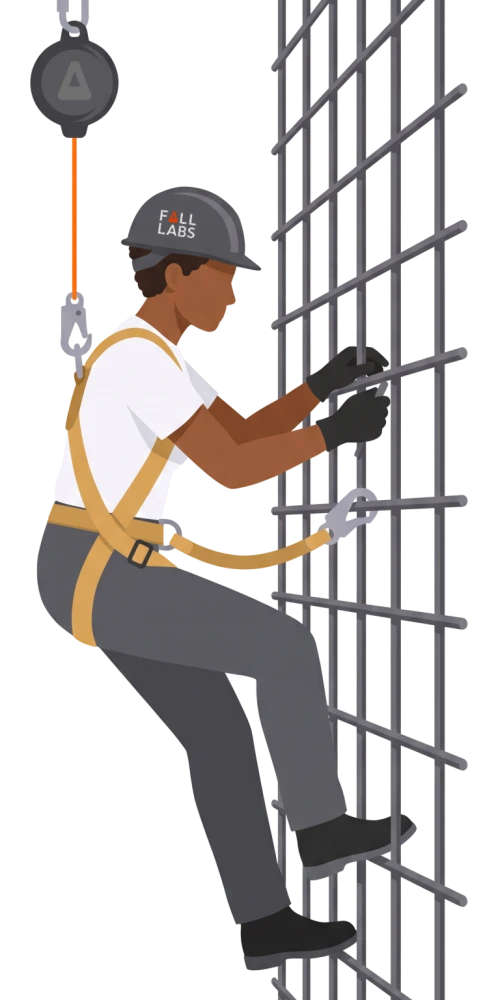
“Tied off” describes a connection, not a system. The same full body harness and lanyard can be part of a travel restraint system, a personal fall arrest system, or a work positioning system, and each is built on a different assumption about whether a fall can happen and how far it can go. Trouble starts when equipment or an anchorage chosen for one is used as if it were another.
The order matters as well. ANSI/ASSP Z359.1-2024, the Fall Protection Code published by the American Society of Safety Professionals (ASSP) and approved by the American National Standards Institute (ANSI), gives the preferred order of controls in a note on program design: prevent or eliminate the exposure, then use passive fall protection such as guardrails, then active systems, with travel restraint ahead of fall arrest. This article is about the active systems, the ones a worker wears.
The three systems side by side
| Travel restraint | Fall arrest | Work positioning | |
|---|---|---|---|
| What it does | Keeps the worker from reaching the fall hazard | Stops a fall after it has started | Supports the worker on a vertical surface with both hands free |
| Can the worker fall? | No, when it is rigged correctly | Yes, and the system is built to stop it | A short fall is possible. Construction limits it to 2 feet or less |
| Body support | Full body harness. OSHA allows a body belt in some cases | Full body harness only | Full body harness, so a fall arrest backup can be attached |
| OSHA anchorage strength | General industry: 5,000 pounds per worker, or a qualified person’s design with a safety factor of at least two. Construction: no general figure in the fall protection rule. Task-specific rules apply | 5,000 pounds per worker, or a qualified person’s design with a safety factor of at least two | Construction: twice the potential impact load or 3,000 pounds, whichever is greater. General industry: 5,000 pounds per worker, or a qualified person’s design with a safety factor of at least two |
Travel restraint: the fall never starts
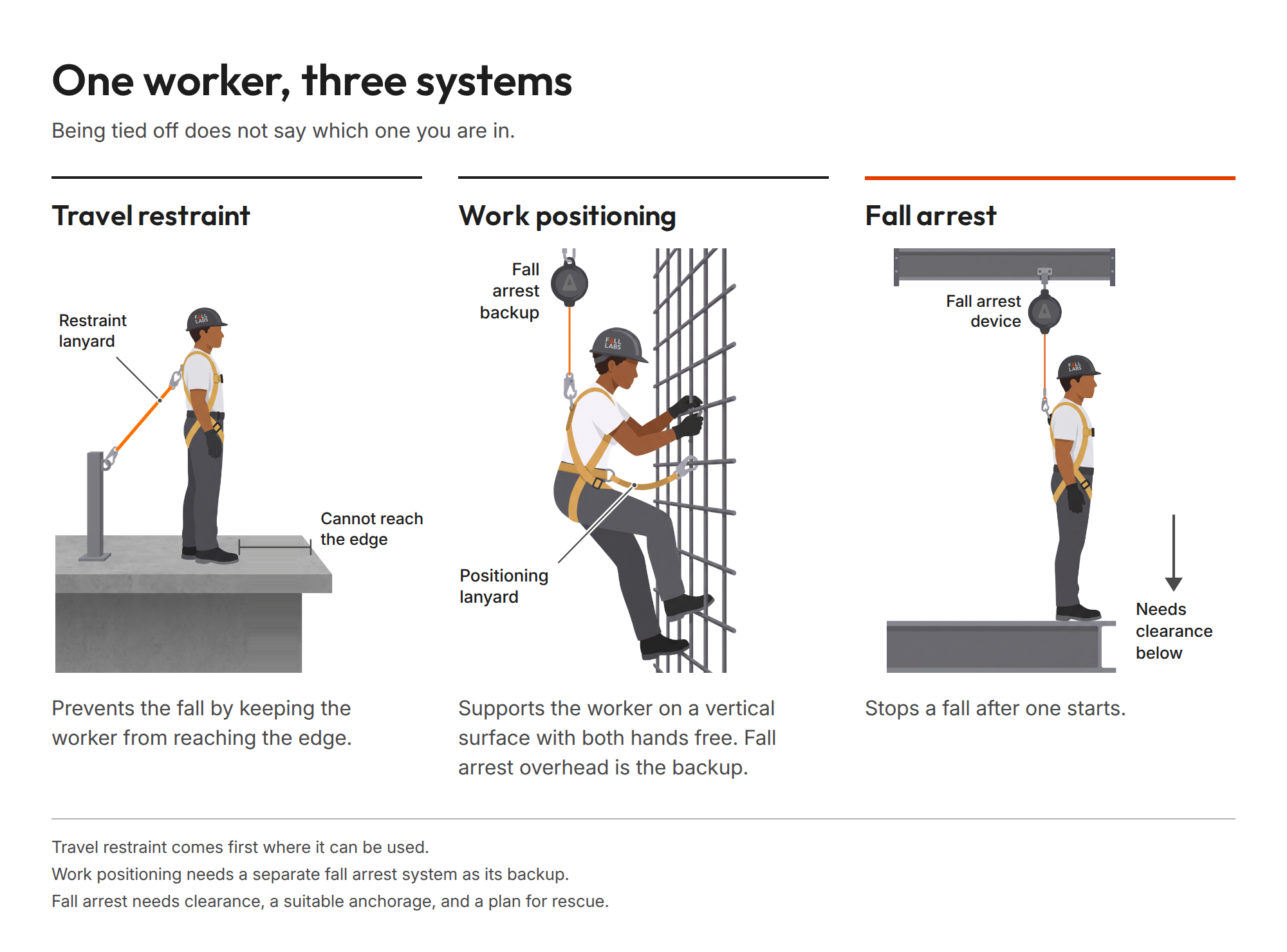
The Occupational Safety and Health Administration (OSHA) defines a travel restraint system in its general industry rules as a combination of an anchorage, anchorage connector, lanyard or other means of connection, and body support used “to eliminate the possibility of an employee going over the edge of a walking-working surface.” The definition in ANSI/ASSP Z359.3 makes the same point: the worker can approach the edge, but the system eliminates the possibility of falling. Many references call this fall restraint. Fall Labs uses the term travel restraint because, when the system is set up correctly, a fall cannot happen.
The test is geometry. The location of the anchorage and the length of the connection have to keep the worker short of every edge, opening, and skylight within reach, in every direction they can move. If the worker can get to a point where a fall is possible, the system is not restraint, whatever the lanyard is called, and it has to meet the requirements for fall arrest. Slope matters too. Z359.6, the standard for designing these systems, does not allow travel restraint on a working surface that slopes down toward the fall hazard at more than 4 in 12, meaning a rise of 4 inches for every 12 inches of horizontal distance, or about 18 degrees.
The rules treat restraint differently depending on the work. General industry lists travel restraint among the personal fall protection systems an employer may use, and its general anchorage requirement applies. Construction’s main fall protection rule does not set general criteria for restraint. OSHA’s Technical Manual says so directly: “OSHA has no specific standards for restraint systems, however, at a minimum, fall restraint systems should have the capacity to withstand at least 3,000 pounds of force or twice the maximum expected force that is needed to restrain the worker from exposure to the fall hazard.” A 1995 OSHA interpretation letter gives the same guidance of at least twice the maximum expected force. Rules for specific kinds of construction work do set requirements. The steel erection rule names fall restraint systems among its accepted methods and requires them to use fall arrest components that meet the fall arrest criteria.
Restraint is the first choice of the three because the fall does not happen, and the Fall Protection Code says as much: in general, systems that prevent a free fall are preferable to systems that arrest one. There is no arresting force on the body, no clearance to work out, and no suspended worker to rescue. OSHA allows a body belt in some restraint systems, but the Z359 standards are written around the full body harness, and Fall Labs recommends a harness for every one of these systems.
Fall arrest: stopping a fall in progress
A personal fall arrest system accepts that the worker may fall and is built to stop the fall within limits the body can tolerate. OSHA’s general industry rules define it as a system used to arrest an employee in a fall from a walking-working surface, made up of a body harness, an anchorage, and a connector, which may include a lanyard, deceleration device, or lifeline.
- Body support is a full body harness. Body belts have not been acceptable for fall arrest in construction since January 1, 1998, and general industry prohibits them as well.
- OSHA limits the maximum arresting force on the worker to 1,800 pounds and requires the system to be rigged so the worker cannot free fall more than 6 feet or contact a lower level, with the limited exceptions explained in our article on fall clearance.
- The anchorage has to support 5,000 pounds per worker attached, or be part of a system designed by a qualified person with a safety factor of at least two.
- It needs room. In the worked example in our article on fall clearance, a 6-foot energy absorbing lanyard anchored at D-ring height needs 13.5 feet of clearance below the working surface.
- It needs a way down. OSHA requires the employer to provide for prompt rescue after a fall, and Fall Labs recommends a written rescue plan.
Fall arrest comes after restraint in the hierarchy because it accepts that the worker may fall as far as the system allows.
Work positioning: held in place to work
OSHA’s construction rules define a positioning device system as “a body belt or body harness system rigged to allow an employee to be supported on an elevated vertical surface, such as a wall, and work with both hands free while leaning.” Tying reinforcing steel on the face of a wall is the familiar example, and the construction rule lists positioning device systems among the protection allowed for work on formwork and reinforcing steel.
In construction, a positioning device has to be rigged so the worker cannot free fall more than 2 feet, and its anchorage has to support at least twice the potential impact load of a fall or 3,000 pounds, whichever is greater. General industry handles positioning systems through a drop test and its general requirements for personal fall protection systems.
A positioning system is not a fall arrest system, and the Z359 standards are plain about it. They describe positioning as the primary system, the one that supports the worker’s weight, and note that many jurisdictions require a secondary system with it. Z359.3 defines a positioning lanyard as one used together with a fall arrest system, and it requires adjustable positioning lanyards to be marked as not for fall arrest. Fall Labs recommends backing up a work positioning system with a separate fall arrest system wherever the worker could fall if the positioning system came loose or was disconnected.
The harness tells you which is which
The attachment points on a full body harness are assigned to these jobs. Under ANSI/ASSP Z359.11-2021, the dorsal D-ring between the shoulder blades is the primary fall arrest attachment and may also be used for travel restraint. Hip D-rings are used as a pair for work positioning or travel restraint and never for fall arrest, and a rear waist attachment, sometimes called a lumbar D-ring, is for travel restraint only. Other attachment points, such as sternal and frontal, have approved uses of their own, and the harness manufacturer’s instructions give the approved use for each one.
Where the mix-ups happen
- A restraint setup with a lanyard long enough for a fall to occur. That is fall arrest without the equipment, clearance, or anchorage for it.
- A positioning lanyard or hip D-rings used as the only protection where a longer fall is possible.
- An anchorage selected for restraint or positioning that is later used for fall arrest.
- Fall arrest connected to the hip D-rings instead of the dorsal D-ring.
- A fall arrest system with no check on the clearance below it.
Choosing by the hazard
Start at the top of the hierarchy. If the hazard can be removed or guarded, do that. If the worker can be kept away from the edge, travel restraint prevents the fall and is the stronger choice. If the work has to be done where a fall is possible, fall arrest is the system, with the clearance, anchorage, and rescue plan it depends on. If the task means leaning into a vertical surface and working with both hands free, positioning holds the worker there, with fall arrest behind it. The question to ask is which system someone is in and whether it fits the hazard, not simply whether they are tied off.
These are federal rules for the United States, and other countries define these systems in their own standards. Whichever system is used, the manufacturer’s instructions for each component govern how it is set up.
For more on fall arrest anchorage strength, see our article on the 5,000-pound anchor rule.
Frequently asked questions
A travel restraint system keeps the worker from reaching the fall hazard, so no fall occurs. A personal fall arrest system stops a fall after it starts.
No. Body belts have not been acceptable for fall arrest in construction since January 1, 1998, and general industry prohibits them. They may be used in positioning systems and, where OSHA allows, restraint.
No. It supports the worker on a vertical surface. Fall Labs recommends backing it up with a separate fall arrest system wherever a fall is possible.
In general industry the general anchorage rule applies: 5,000 pounds per worker, or a qualified person’s design with a safety factor of at least two. Construction’s main fall protection rule sets no general figure for restraint, and OSHA’s guidance is at least 3,000 pounds or twice the maximum expected force.
Sources12
- OSHA 29 CFR 1910.140(b), (c)(13), (d), and (e), definitions, anchorages, personal fall arrest systems, and positioning systems (general industry).
- OSHA 29 CFR 1910.28(b)(1)(i), personal fall protection systems permitted (general industry).
- OSHA 29 CFR 1926.500(b), 1926.501(b)(5), and 1926.502(d) and (e), definitions, formwork and reinforcing steel, personal fall arrest systems, and positioning device systems (construction).
- OSHA 29 CFR 1926.760(a)(1), fall protection methods in steel erection.
- OSHA 29 CFR 1926.760(d)(2), fall restraint in steel erection.
- OSHA Technical Manual, Section V, Chapter 4, Fall Protection in Construction.
- OSHA Standard Interpretation, November 2, 1995, restraint systems.
- ANSI/ASSP Z359.0-2023, Definitions and Nomenclature Used for Fall Protection and Fall Arrest.
- ANSI/ASSP Z359.1-2024, The Fall Protection Code.
- ANSI/ASSP Z359.3-2019, Safety Requirements for Lanyards and Positioning Lanyards.
- ANSI/ASSP Z359.6-2026, Specifications and Design Requirements for Active Fall Protection Systems.
- ANSI/ASSP Z359.11-2021, Safety Requirements for Full Body Harnesses.
Last reviewed: October 2026.
This article is for general informational purposes only. It is not legal, medical, or engineering advice, and it does not replace hands-on training, a site-specific hazard assessment, or the judgment of a competent or qualified person. Always follow the manufacturer’s instructions for your equipment and the regulations that apply where you work, and check with the authority having jurisdiction when in doubt. Standards, regulations, and research cited here were current when this article was written and may since have been revised, reaffirmed, or withdrawn. Fall Labs makes no warranty as to the completeness or accuracy of this information and is not responsible for how it is used. References to OSHA, ANSI, the American Society of Safety Professionals, or any other organization do not imply their endorsement.