

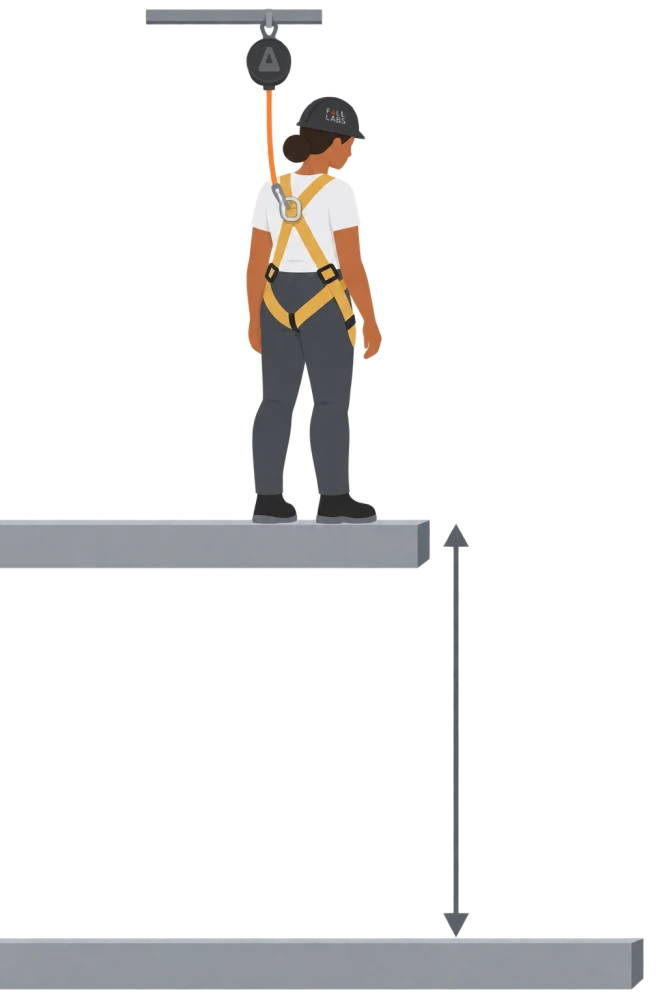
Every personal fall arrest system is expected to do one thing: stop a falling worker before they reach the level below. Whether it can depends on a number that is easy to skip, the total distance the worker travels from the start of the fall until they come to rest, plus a margin. The U.S. Bureau of Labor Statistics (BLS) counted 666 workplace deaths from falls to a lower level in 2024. A fall arrest system rigged without enough room below it can let a worker strike the ground or a lower surface even when every component works exactly as designed.
The lanyard length is only the first term in that calculation. Below, each term is explained, two examples are worked, and the results show how much the anchorage location changes the answer. Where the fall hazard can be removed by design, guarded, or controlled with a restraint system that keeps the worker from reaching the edge, those options come first. Clearance becomes the question once fall arrest is the control.
What OSHA requires
The Occupational Safety and Health Administration (OSHA) does not publish a clearance figure, but it sets the limits that drive one. In construction, OSHA requires a personal fall arrest system to be rigged so the worker can neither free fall more than 6 feet nor contact any lower level, and it limits deceleration distance to 3.5 feet. General industry sets the same limits, but allows a longer free fall when the system is designed and tested to keep the arresting force at or below 1,800 pounds.
OSHA has also said a construction employer may exceed 6 feet of free fall where no anchorage allows less, as long as the arresting force limit is still met. Lanyards rated for a 12-foot free fall are built for that situation.
The phrase that matters most is “nor contact any lower level.” Staying within the free fall and deceleration limits does not satisfy that requirement by itself. The system also has to stop the worker with room to spare, and the way to know is to add up the whole fall. OSHA’s own appendix guidance for construction and general industry makes the same point, stating that elongation and deceleration distance must be added to the free fall distance to arrive at the total fall distance. These are United States rules, and other countries set their own.
The terms you add up
Clearance is measured from the working surface down to the nearest obstruction, whether that is the ground, a lower floor, a piece of equipment, or anything else the worker could strike. The American National Standards Institute (ANSI) standard for designing fall protection systems, Z359.6, builds clearance by adding up each part of the fall. For a worker standing and connected at or above the D-ring, it comes down to four terms:
- Free fall: how far the worker drops before the system begins to arrest the fall. For a lanyard, it is the lanyard length plus the height of the dorsal D-ring above the anchorage, or less when the anchorage is above the D-ring. OSHA counts any slide or extension that happens before a device locks as part of free fall.
- Deceleration distance: how far the worker travels while the energy absorber or self-retracting device stops the fall. Use the maximum on the product label. On a lanyard it is listed as the maximum deployment distance or maximum elongation: up to 4 feet for a lanyard rated for 6 feet of free fall and up to 5 feet for one rated for 12 feet, under Z359.13. Those figures are higher than OSHA’s 3.5 feet because the ANSI test uses a heavier test weight, and the label figure is the one to plan with. If the planned free fall is more than 6 feet, use a lanyard rated for that free fall. On a self-retracting device the label gives an arrest distance, which includes the short distance the device takes to lock. These ratings cover users from 130 to 310 pounds, including clothing, tools and equipment. A heavier worker needs equipment rated for that weight, and its label sets the numbers.
- Harness stretch: how far the worker drops within the harness as it takes the load, including the webbing stretching and the D-ring sliding up the back. Z359.11 limits it to 18 inches (1.5 feet), or less if the manufacturer states less.
- Clearance margin: extra room between the worker’s lowest point and the obstruction, for everything the calculation cannot predict. Z359.6 requires at least 2 feet on a rigid anchorage and more on a flexible one such as a horizontal lifeline. OSHA’s fall arrest rules do not give a number for the margin. They require that the system prevent contact with a lower level. Fall Labs recommends never using less than 2 feet.
In these standing-worker examples, the worker’s height is not added separately because clearance is measured from the working surface. D-ring height still affects free fall relative to the anchorage, and body posture can change the clearance required. When measuring from the anchorage instead, account for the worker’s body below the D-ring as the manufacturer directs. Mixing the two reference points can give the wrong answer.
Some conditions add distance. A worker who falls from a kneeling position can need about 30 inches more clearance than a standing worker. A heavier worker can deploy an energy absorber further than a lighter one, and an anchorage off to one side adds a swing that lengthens the fall and can carry the worker into an obstruction.
Both examples below use the same harness. Assume its instructions give a harness stretch of 1.5 feet.
Example 1: a 6-foot lanyard at D-ring height
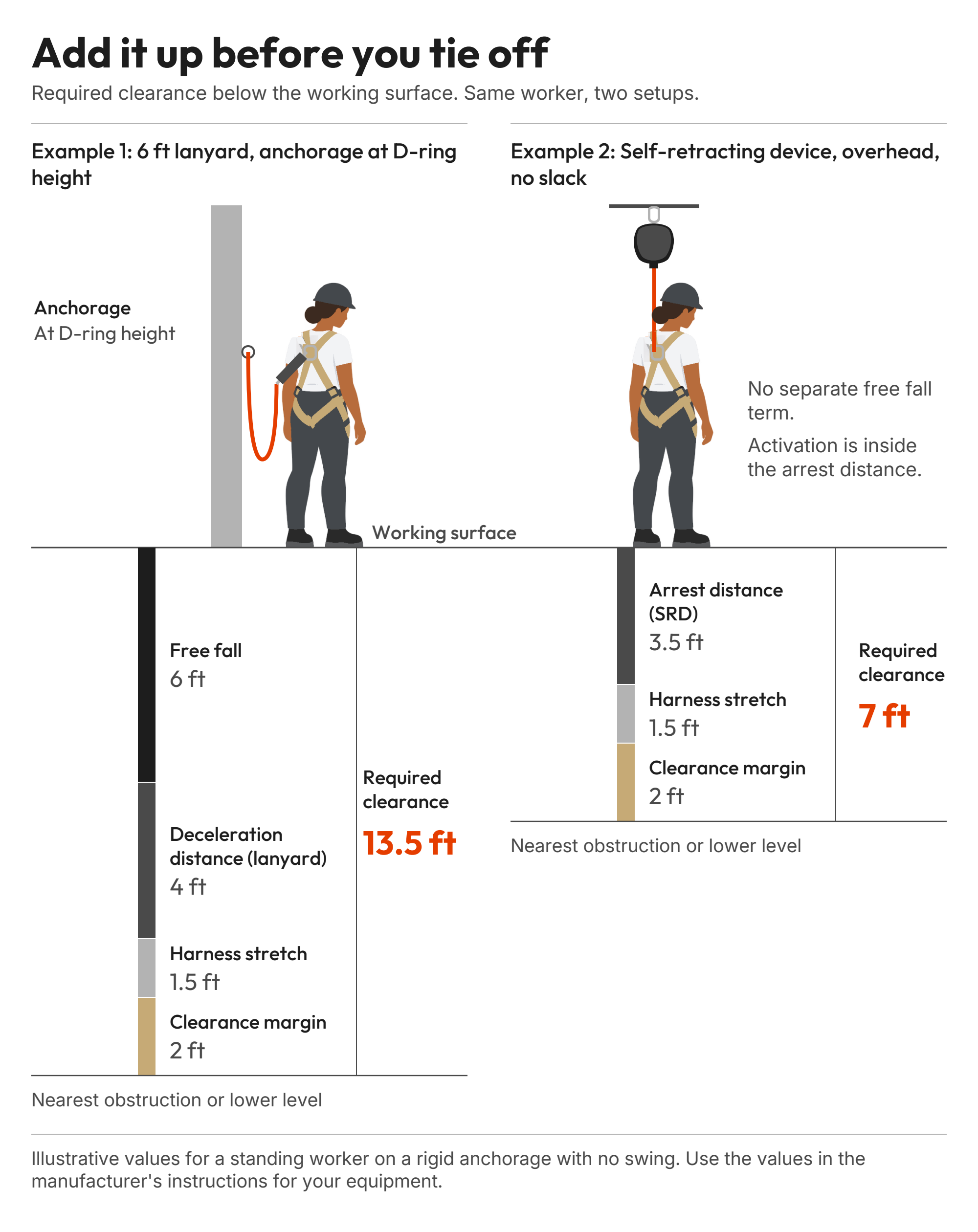
Take a worker about 6 feet tall whose dorsal D-ring sits about 5 feet above the working surface. They wear a 6-foot energy absorbing lanyard connected to a rigid anchorage at the same height as the D-ring. The lanyard’s label gives a maximum deceleration distance of 4 feet, the Z359.13 limit for a 6-foot free fall energy absorber.
- Free fall: 6 feet, the lanyard length, since the anchorage is level with the D-ring.
- Deceleration distance: 4 feet, from the lanyard’s label.
- Harness stretch: 1.5 feet.
- Clearance margin: 2 feet.
Total: 13.5 feet of clearance below the working surface. A lower floor, a railing, a vehicle, or anything else within 13.5 feet of the platform is in the way. Measured from the anchorage instead, the same fall needs 18.5 feet: the 13.5 feet below the working surface plus the 5 feet the anchorage sits above it. Both answers are right, as long as each is measured from its own reference point. Some manufacturer instructions measure from the anchorage using the worker’s full height and a combined allowance for harness stretch and D-ring slide, so their totals can differ from the one here. Follow the method in the instructions for the product you are using.
Example 2: move the anchorage overhead
Now connect the same worker to a self-retracting device anchored directly overhead, with no slack in the line. Directly overhead also keeps swing to a minimum, which the Canadian Centre for Occupational Health and Safety recommends. A self-retracting device anchored overhead locks within a short distance, and Z359.14 limits its arrest distance to 42 inches (3.5 feet), including the distance it takes to lock. Assume this device’s label gives an arrest distance of 3.5 feet, the Z359.14 limit, and the worker wears the same harness.
- Free fall: included in the arrest distance below, so it is counted once.
- Arrest distance: 3.5 feet, from the device’s label.
- Harness stretch: 1.5 feet.
- Clearance margin: 2 feet.
Total: 7 feet below the working surface for this example, compared with 13.5 feet for the lanyard. Moving the anchorage from D-ring height to overhead and switching from a lanyard to a self-retracting device made the difference. Where you connect sets how far you fall before anything engages, and the connecting device sets how far you travel while it stops you. Confirm the result against the device’s own instructions.
Fall Labs recommends tying off as high as possible. A worker may have several places to connect, but where the choice is between an overhead anchorage and one at the feet, overhead is always preferred, unless a competent person determines it would create other hazards.
When the anchorage is at your feet
Tying off to the working surface turns the height of the D-ring into extra free fall. OSHA has described a 6-foot lanyard anchored at foot level as producing about 10 feet of free fall: the lanyard plus the 4 to 4.5 feet from harness to floor. With the 5-foot D-ring height used in the examples above, it is 11 feet. In construction, OSHA accepts it only where no more suitable anchorage or other fall protection is available, with the free fall kept as short as possible.
A lanyard built for a 6-foot free fall is not built for that fall. Equipment rated for a longer free fall exists, but it also deploys further, up to 5 feet, and needs more clearance below. A self-retracting device at foot level is a different case. Only a Class 2 device is made for an anchorage below the D-ring, and its clearance comes from the chart in its instructions, not the 3.5 feet used in Example 2. That is why Fall Labs puts overhead first: wherever a higher anchorage can be found, it is the better fix.
Common errors to check
- Treating the lanyard length as the whole fall.
- Leaving out deceleration distance or harness stretch.
- Measuring from the anchorage and forgetting to subtract its height above the working surface, or adding the worker’s height when measuring from the working surface.
- Assuming the anchorage is at D-ring height when it is actually at the feet.
- Leaving out the margin, or using 2 feet on a flexible anchorage such as a horizontal lifeline that needs more.
- Ignoring swing from an anchorage that is off to the side.
When the total is more than the clearance available, a longer lanyard is not the answer. Raise the anchorage, shorten the connection, or change the approach, for example to an overhead self-retracting device, a restraint system, or an engineered system designed by a qualified person. The manufacturer’s instructions for each component give the values to use, and they govern wherever they differ from the planning figures here.
| Term | Example 1: 6 ft lanyard, D-ring height | Example 2: SRD, overhead, no slack | |
|---|---|---|---|
| Free fall. How far the worker drops before the system engages. | 6 ft | No separate term. Activation is inside the arrest distance. | |
| Deceleration distance (lanyard) / Arrest distance (SRD). From the label. Lanyard: maximum deployment distance. SRD overhead: arrest distance. | 4 ft | 3.5 ft | |
| Harness stretch. From the harness instructions, up to 1.5 ft. | 1.5 ft | 1.5 ft | |
| Clearance margin. Fall Labs recommends never less than 2 ft. | 2 ft | 2 ft | |
| Required clearance below the working surface | 13.5 ft | 7 ft |
Fall Clearance Worksheet Measured below the working surface.
| Free fall. How far the worker drops before the system engages. | 6 ft |
|---|---|
| Deceleration distance (lanyard) / Arrest distance (SRD). From the label. Lanyard: maximum deployment distance. SRD overhead: arrest distance. | 4 ft |
| Harness stretch. From the harness instructions, up to 1.5 ft. | 1.5 ft |
| Clearance margin. Fall Labs recommends never less than 2 ft. | 2 ft |
| Required clearance below the working surface | 13.5 ft |
| Free fall. How far the worker drops before the system engages. | No separate term. |
|---|---|
| Activation is inside the arrest distance. | |
| Deceleration distance (lanyard) / Arrest distance (SRD). From the label. Lanyard: maximum deployment distance. SRD overhead: arrest distance. | 3.5 ft |
| Harness stretch. From the harness instructions, up to 1.5 ft. | 1.5 ft |
| Clearance margin. Fall Labs recommends never less than 2 ft. | 2 ft |
| Required clearance below the working surface | 7 ft |
Download the printable worksheet (PDF)
Illustrative values for a standing worker on a rigid anchorage with no swing. Use the values in the manufacturer’s instructions for your equipment.
Swing falls and self-retracting devices used below the D-ring or over an edge are covered in our Standards Decoded guide, Fall clearance and the physics of a fall. Horizontal lifelines add terms of their own and need the system manufacturer’s figures.
Sources
- U.S. Bureau of Labor Statistics, Census of Fatal Occupational Injuries Summary, 2024, and Table 2.
- OSHA 29 CFR 1926.502(d)(16)(iii) and (iv), free fall, lower level contact, and deceleration distance (construction).
- OSHA 29 CFR 1910.140(d)(1)(ii) and (d)(2)(ii), deceleration distance, free fall, and lower level contact (general industry).
- OSHA 29 CFR 1926.500(b) and 1910.140(b), definitions of free fall distance and deceleration distance.
- OSHA 29 CFR 1926 Subpart M, Appendix C, and 1910 Subpart I, Appendix C, total fall distance and tie-off location guidance, and the construction test methods.
- OSHA Standard Interpretation, December 4, 1996, exceeding the 6-foot free fall limit (construction).
- OSHA Standard Interpretation, September 21, 2007, foot-level tie-off and free fall.
- Canadian Centre for Occupational Health and Safety, Fall Protection: Fall Arrest Systems, OSH Answers.
- ANSI/ASSP Z359.6-2026, Specifications and Design Requirements for Active Fall Protection Systems.
- ANSI/ASSP Z359.11-2021, Safety Requirements for Full Body Harnesses.
- ANSI/ASSP Z359.13-2013 (R2022), Personal Energy Absorbers and Energy Absorbing Lanyards.
- ANSI/ASSP Z359.14-2021, Safety Requirements for Self-Retracting Devices for Personal Fall Arrest and Rescue Systems.
Last reviewed: October 2026.
This article is for general informational purposes only. It is not legal, medical, or engineering advice, and it does not replace hands-on training, a site-specific hazard assessment, or the judgment of a competent or qualified person. Always follow the manufacturer’s instructions for your equipment and the regulations that apply where you work, and check with the authority having jurisdiction when in doubt. Standards, regulations, and research cited here were current when this article was written and may since have been revised, reaffirmed, or withdrawn. Fall Labs makes no warranty as to the completeness or accuracy of this information and is not responsible for how it is used. References to OSHA, ANSI, the American Society of Safety Professionals, or any other organization do not imply their endorsement.