

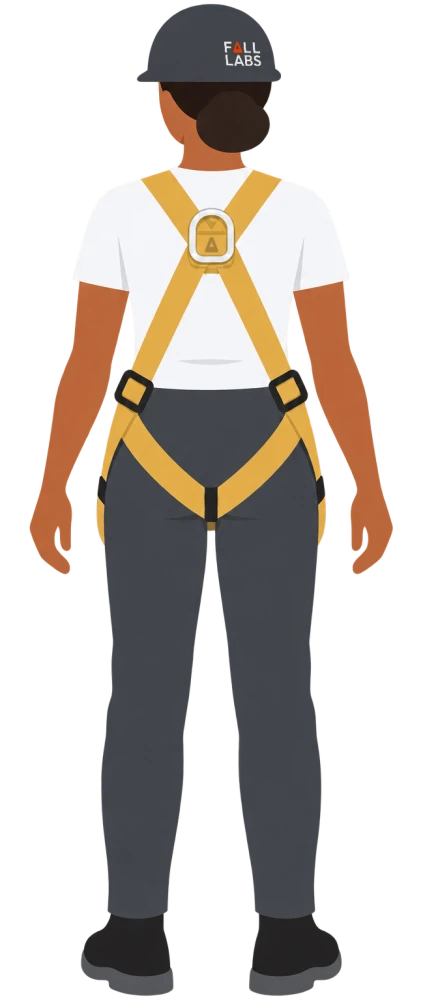
Many workers put on a full body harness the same way every day: step in, buckle up, clip the lanyard to the D-ring on the back, and get to work. What rarely gets a second look is where that D-ring ended up. A harness pulled on in a hurry can leave it riding up toward the base of the neck or sagging toward the waist, and because it sits behind the worker, the person wearing it cannot see it.
That matters because the performance of the whole fall arrest system assumes a harness that is fitted and worn as intended. When the fall hazard cannot be eliminated and workers rely on fall arrest, the position of the dorsal D-ring is easy to overlook and quick to fix. This article covers where it belongs, what the rules and standards say, and how to check it before going up.
What the dorsal D-ring does
The dorsal D-ring is the attachment element in the center of the back of a full body harness. ANSI/ASSP Z359.11-2021, the American National Standard for full body harnesses published by the American Society of Safety Professionals (ASSP), requires every harness built to it to include one permanently and makes it the primary fall arrest attachment, unless the application calls for one of the limited alternatives covered below. In a fall, the harness is designed to direct the load from the dorsal D-ring through the shoulder straps and around the thighs, and the standard describes the worker hanging from it afterward in an upright position with a slight forward lean.
What OSHA requires
In the United States, the Occupational Safety and Health Administration (OSHA) sets where the attachment point is worn. In construction, 29 CFR 1926.502(d)(17) requires the attachment point of a body harness to be located in the center of the wearer’s back near shoulder level, or above the wearer’s head. In general industry, 29 CFR 1910.140(c)(22) requires personal fall protection systems to be worn with the attachment point in the center of the employee’s back near shoulder level, and allows the pre-sternal position, on the chest, only if the free fall distance is limited to 2 feet (0.6 m) or less. This article covers the United States, and other countries set their own requirements.
General industry adds a performance requirement that a well-fitted harness helps meet. Under 1910.140(d)(1)(iv), a personal fall arrest system must hold the employee within the system and strap configuration without contact with the neck and chin area.
Where it should sit
Center of the back near shoulder level is the regulatory wording, and in practice that generally puts the D-ring between the shoulder blades. Researchers at the National Institute for Occupational Safety and Health (NIOSH) describe the general understanding as a dorsal D-ring positioned between the lower and upper borders of the shoulder blades while the worker is standing. Where a harness has its own marking or instruction for D-ring position, follow the manufacturer’s instructions.
A D-ring well above or below that zone can signal loose shoulder straps or a harness that is the wrong size for the worker. Check fit and sizing first, then set a sliding D-ring according to the manufacturer’s instructions.
Why position and fit matter in a fall
Z359.11 tests the dorsal D-ring by dropping a weighted test torso both feet first and head first. After each drop, the harness must hold the torso for five minutes at no more than 30 degrees from vertical. Those results come from a harness mounted on a test torso as the standard specifies. A harness worn loose, or with the D-ring well out of position, may not hold a real worker the same way.
How the harness fits also matters after the fall is arrested. In a 2012 NIOSH study, 37 people with construction experience were suspended from the dorsal D-ring of a full body harness. Workers whose torso hung more than 35 degrees from vertical, and workers in a poorly fitting harness size, tolerated suspension for less time on average than those whose harness fit well. That 35-degree figure is a research measurement on people, not a test limit in Z359.11. Our article on suspension trauma covers why that matters. The practical point here is to check the fit of the whole harness, including its size, strap adjustment, and D-ring position, rather than treating D-ring location as the only measure of proper fit.
Sliding or fixed
Some harnesses have a fixed dorsal D-ring, and others have one that slides along the webbing. Z359.11 notes that a sliding D-ring fits a wider range of wearers and can hang the worker more upright after a fall, at the cost of some added harness stretch. Harness stretch is part of the total fall distance, and in the dynamic test the standard limits it to 18 inches (457 mm) or the manufacturer’s stated value, whichever is less. Both designs are acceptable, as long as you know which one you have, set it according to the manufacturer’s instructions, and include harness stretch in the clearance calculation.
Other attachment points are not substitutes
A full body harness may carry several other attachment elements, and Z359.11 gives each a defined job:
- Sternal, on the chest: an alternative fall arrest attachment only where a competent person has determined the dorsal D-ring is inappropriate and a fall can only happen feet first, with the standard advising a likely fall distance of 2 feet (0.6 m) or less. Accepted uses include ladder climbing and rope access, among others. Its drop test allows a post-fall angle of up to 50 degrees from vertical, compared with 30 degrees for the dorsal D-ring.
- Frontal, at the waist: ladder climbing with a guided type fall arrester where only a feet-first fall is possible, plus work positioning and other limited uses.
- Hip, the side D-rings: work positioning, never fall arrest.
- Shoulder: used as a pair for rescue and entry or retrieval, not fall arrest.
- Waist rear: travel restraint only.
The dorsal D-ring is the only attachment Z359.11 drop tests both feet first and head first, and the other attachments come with use limits.
Check it every time
Z359.11 requires harness instructions to stress correct fit and sizing, including snug straps, a centered chest strap, and leg straps placed to avoid groin contact in a fall. The manufacturer’s instructions for your harness are the place to start.
Our recommendation is to finish every fitting with a D-ring check. Because the worker cannot see it, a coworker can confirm that the D-ring is centered between the shoulder blades and the shoulder straps are snug before anyone goes up. It takes a few seconds and helps confirm the harness is worn the way it was designed and tested.
We will take up harness sizing and fit across different body types in future articles.
Sources
- OSHA 29 CFR 1926.502(d)(17), attachment point location (construction).
- OSHA 29 CFR 1910.140(c)(22) and (d)(1)(iv), attachment point location and neck and chin contact (general industry).
- ANSI/ASSP Z359.11-2021, Safety Requirements for Full Body Harnesses.
- Hsiao, Turner, Whisler, and Zwiener (NIOSH). Impact of harness fit on suspension tolerance. Human Factors, 54(3), 346 to 357, 2012.
Last reviewed: September 2026.
This article is for general informational purposes only. It is not legal, medical, or engineering advice, and it does not replace hands-on training, a site-specific hazard assessment, or the judgment of a competent or qualified person. Always follow the manufacturer’s instructions for your equipment and the regulations that apply where you work, and check with the authority having jurisdiction when in doubt. Standards, regulations, and research cited here were current when this article was written and may since have been revised, reaffirmed, or withdrawn. Fall Labs makes no warranty as to the completeness or accuracy of this information and is not responsible for how it is used. References to OSHA, ANSI, ASSP, or any other organization do not imply their endorsement.