

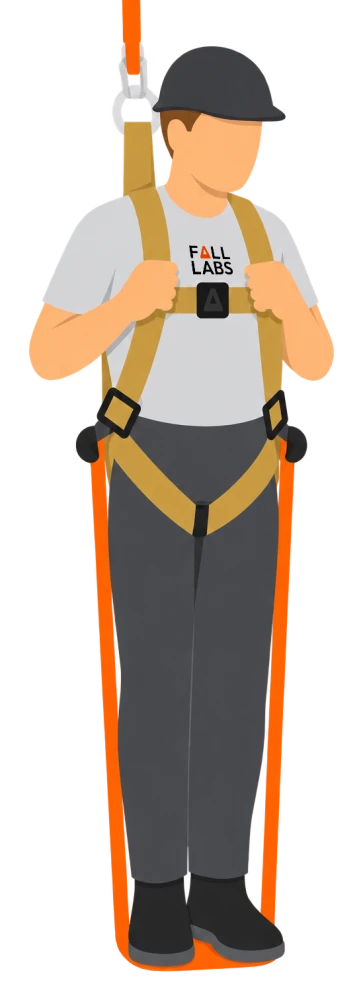
A worker falls. The fall arrest system works as intended. The lifeline locks, the harness holds, and the worker is suspended in the air instead of hitting the ground. To anyone watching, the emergency might look over but often it is not and can be the start of a second emergency.
Suspension trauma, also called orthostatic intolerance, is what can happen to a worker left hanging in a full body harness after a fall. Medical researchers now prefer the term suspension syndrome, because the worker does not need to be physically injured for it to happen. The exact mechanism is still being studied, but the main pieces are known. Gravity pulls blood down into the legs, where it pools, and less blood returns to the heart. At some point the body can respond with a sudden nervous system reflex that drops the heart rate and blood pressure, and the brain, sitting at the top of the body, loses the blood supply it needs. The worker feels faint and can lose consciousness. In an ordinary faint, the body usually recovers by collapsing flat. In a harness, the worker is held upright and cannot lie flat. Left long enough, suspension syndrome can cause serious injury or death. The good news is that it is often preventable, and the science has improved considerably over the last decade. Some older training and literature has not caught up, which is why this topic is worth understanding.
Why standing still can make you faint
To understand why suspension is dangerous, let’s start with something ordinary. Why does a soldier standing rigidly at attention sometimes faint after long periods?
Blood has to travel uphill from the legs back to the heart. Arteries have the push of the heartbeat behind them, so sending blood down into the legs is easy. Veins do not have that push. They are low-pressure pipes fighting gravity. What moves blood back up is the leg muscles themselves. Every step or shift of weight squeezes the calf muscles against the veins and forces blood upward, and small one-way valves stop it from flowing back. The calf is the primary pump keeping blood out of the legs when a person is upright.
Stand perfectly still and the pump switches off. Blood begins to pool. The body compensates for a while, but stay rigid long enough and blood pressure can fall, the brain receives less oxygen, and the person faints. That is the fainting soldier.
Fainting is the body’s own fix. The soldier drops to the ground, and their legs, heart, and head land on the same level. Gravity is no longer pulling blood away from the brain, blood flow to the brain recovers, and most people come around quickly. Lying flat is not just a side effect of fainting. It is a natural way the body often recovers.
Why a harness is worse than standing still
Put the same person in a full body harness after a fall arrest and the manageable problem becomes a potentially life-threatening one. Three things stack up at once.
First, the worker often cannot move. After a fall arrest, the worker may be dazed, injured, exhausted, or unconscious. The leg muscles that run the pump are not slowed but stopped. Blood pools with nothing pushing back.
Second, the straps add pressure. The leg straps carry the worker’s full body weight and press into the thighs. For years, that pressure was taught as the main cause: the theory was that the straps pinch the large veins, so blood gets into the legs but struggles to get out. Harness design, attachment point, fit, pain, and injuries all appear to affect how long a person can tolerate a still suspension, but exactly how much the straps themselves contribute is not settled.
A 2020 ultrasound study in healthy volunteers found that the main thigh vein stayed open during suspension, which suggests the straps are not simply pinching it shut. Blood still pooled in the legs, but the amount of pooling did not predict who came close to fainting. A 2019 suspension study points to the sudden nervous system reflex described above as a key part of the collapse. The honest picture is that pooling, the reflex, pain, and injuries all play a part, and researchers are still working out how they fit together. None of that makes harness fit less important. A harness that is selected, fitted, and adjusted according to the manufacturer’s instructions is more tolerable to hang in, and that matters when a worker may be waiting for rescue.
Third, the harness holds the worker upright. If the worker starts to faint, the body cannot fall flat to recover. The natural fix is blocked, and a faint that would normally pass once the person is lying down can become life-threatening in a harness.
How long do you have?
The popular timing numbers are shakier than they sound. Training materials repeat “death in four to six minutes” and “unconsciousness, followed by death, in less than 30 minutes.” Even OSHA’s bulletin on the subject includes the 30-minute figure, and it cites a training handout, not a study. No study can ethically measure how long a suspended person survives, so no one can put a reliable number on it.
What the research does show is how much people vary. In a NIOSH study of 40 people with construction experience hanging motionless in full body harnesses, tests were stopped when a subject showed warning signs such as a drop in blood pressure or heart rate, asked to come down, or reached the 60-minute limit. With the back D-ring, suspension times ranged from 5 to 56 minutes. In a 2019 study, 30 percent of tests ended early with signs of near-fainting, at times ranging from about 13 minutes to an hour. These are tolerance times, not survival times, but they make the point: some people are in trouble within minutes, and there is no way to know in advance who.
The honest takeaway is not a countdown. A suspended worker can get into serious trouble quickly and unpredictably, especially if injured or unconscious, so rescue has to start as soon as the fall happens and be measured in minutes. Many organizations have good policies to make sure workers have the right fall protection equipment, but the rescue plan is often overlooked until someone has to figure out, in the moment, how to raise or lower a fallen worker to safety.
Know the warning signs. A suspended worker heading toward a faint may feel light-headed, dizzy, or nauseous, look pale, sweat, have hot flashes, become short of breath, have blurred or graying vision, or become confused or less responsive. Symptoms are a reason to hurry, not the signal to start. Rescue should already be underway.
The part a lot of training still gets wrong
If a training program still teaches the version below, it is behind current medical guidance.
For years, a common piece of advice after rescuing a suspended worker was to keep them sitting upright, sometimes for 30 minutes or more, instead of laying them flat. The theory was that blood pooled in the legs had turned toxic, and laying the worker down would send it rushing back to the heart and stop it. The idea even had a name: reflow, or rescue death.
The evidence does not support it. The idea rested on expert opinion and was never proven. An evidence review published by the UK Health and Safety Executive in 2009 found no basis for keeping rescued workers upright. In 2021, the Australian and New Zealand Committee on Resuscitation found “no evidence to support this practice and it may be harmful.” In 2023, the medical commission of the International Commission for Alpine Rescue recommended laying the rescued person flat.
Current guidance is the reverse, and it is standard first aid. Call emergency services as soon as the fall happens, at the same time your own rescue team goes to work. Get the worker down as fast as it can be done safely. Once the worker is down, lay them flat, loosen or remove the harness, and check for injuries from the fall. From there, follow standard first aid and CPR training and the emergency dispatcher’s instructions until responders arrive. Every rescued worker should be evaluated by a medical professional, however short the suspension, and responders should be told the worker was suspended so they can watch for delayed complications.
The change matters. Keeping a worker who may be close to fainting upright works against the body’s natural fix. A long suspension can cause real complications, which is why medical follow-up matters, but the evidence does not support the idea that laying the worker down causes them.
What to actually do
The obvious and most important factor in protecting workers at height is to prevent the fall in the first place by engineering out the fall hazard, but sometimes that is not possible. If fall arrest equipment is necessary and a fall occurs, two things can help protect the worker: keeping the suspension from becoming dangerous and getting the worker down fast.
Prevention starts with movement. A conscious worker waiting for rescue should keep the legs moving, pushing against a foothold or pumping the calf muscles, for the same reason a soldier at attention is taught to keep the knees slightly bent rather than locked. Many full body harnesses include suspension relief straps, a small textile loop or steps the worker deploys and stands in while suspended. Standing in them takes load off the leg straps and lets the worker push with the legs. ANSI/ASSP Z359.11-2021 notes that a suspension relief device can take tension off the legs and delay the onset of suspension intolerance. Suspension relief straps can be a valuable addition to a harness used for work at height, particularly where extended suspension after a fall is a realistic risk. They have a hard limit. A worker who is unconscious or badly injured cannot deploy them or stand in them, which is exactly the case where they would matter most. Relief straps are a bridge to rescue, not a replacement for one.
What saves the worker is a rescue plan that can bring them down fast, in place before anyone goes up. There is a saying in the trade: 9-1-1 is not a rescue plan. Call emergency services every time. The problem is relying on them as the only plan. Outside responders have to arrive, find a way to reach a worker hanging in the air, and bring that worker down safely, and many are not equipped for a high-angle rescue. Often the worker cannot wait that long.
The duty sits with the employer. In construction, OSHA 29 CFR 1926.502(d)(20) requires the employer to provide for prompt rescue of employees in the event of a fall, or assure that employees are able to rescue themselves. In general industry, 29 CFR 1910.140(c)(21) requires the employer to provide for prompt rescue of each employee in the event of a fall. OSHA has said that the construction provision does not require a written rescue plan, and that prompt means quickly enough to prevent serious injury to the worker. ANSI/ASSP Z359.11-2021 goes further: harness instructions must require the user to have a rescue plan and the means at hand to carry it out when using the harness for fall arrest. Our recommendation goes further still: trained people, the right rescue equipment on site, and a plan that has been practiced, ready to bring a suspended worker down in minutes. As Rupert Noton and J. Nigel Ellis write in Fall Protection Engineering, “Planning for rescue requires developing and practicing rescue plans.”
What we still do not know
Not everything in the science is settled. Researchers agree that blood pools in the legs during motionless suspension, but not on how much the straps contribute, what triggers the sudden reflex behind the collapse, or how to predict who will be affected and when. The old idea that laying a rescued worker flat causes a deadly rush of toxic blood has not been supported by evidence. The complications of a long suspension are real and need medical follow-up. What is settled is the practical answer: prevent the fall where you can, and when you cannot, be ready to get the worker down fast.
Sources
International Commission for Mountain Emergency Medicine (ICAR MEDCOM). Suspension syndrome: a scoping review and recommendations. Scandinavian Journal of Trauma, Resuscitation and Emergency Medicine, 2023.
Australian and New Zealand Committee on Resuscitation (ANZCOR). Guideline 9.1.5, First Aid Management of Harness Suspension Trauma, April 2021.
UK Health and Safety Executive. Research Report RR708, Evidence based review of the current guidance on first aid measures for suspension trauma, 2009.
Turner, Wassell, Whisler, and Zwiener (NIOSH). Suspension tolerance in a full-body safety harness, and a prototype harness accessory. Journal of Occupational and Environmental Hygiene, 2008.
Rauch et al. Suspension syndrome: a potentially fatal vagally mediated circulatory collapse, an experimental randomized crossover trial. European Journal of Applied Physiology, 2019.
Rauch et al. Venous pooling in suspension syndrome assessed with ultrasound. Wilderness & Environmental Medicine, 2020.
OSHA Safety and Health Information Bulletin SHIB 03-24-2004, Suspension Trauma/Orthostatic Intolerance, updated 2011.
OSHA 29 CFR 1926.502(d)(20), personal fall arrest systems, prompt rescue (construction).
OSHA 29 CFR 1910.140(c)(21), personal fall protection systems, prompt rescue (general industry).
OSHA Standard Interpretation, December 18, 2003, prompt rescue and rescue plans under 1926.502(d)(20).
ANSI/ASSP Z359.11-2021, Safety Requirements for Full Body Harnesses.
Rupert Noton and J. Nigel Ellis, Fall Protection Engineering, American Society of Safety Professionals, 2026.
Building or reviewing a rescue plan is its own subject, and we will cover it in future articles.
Last reviewed: September 2026.
This article is for general informational purposes only. It is not legal, medical, or engineering advice, and it does not replace hands-on training, a site-specific hazard assessment, or the judgment of a competent or qualified person. Always follow the manufacturer’s instructions for your equipment and the regulations that apply where you work, and check with the authority having jurisdiction when in doubt. Standards, regulations, and research cited here were current when this article was written and may since have been revised, reaffirmed, or withdrawn. Fall Labs makes no warranty as to the completeness or accuracy of this information and is not responsible for how it is used. References to OSHA, ANSI, ASSP, or any other organization do not imply their endorsement.