

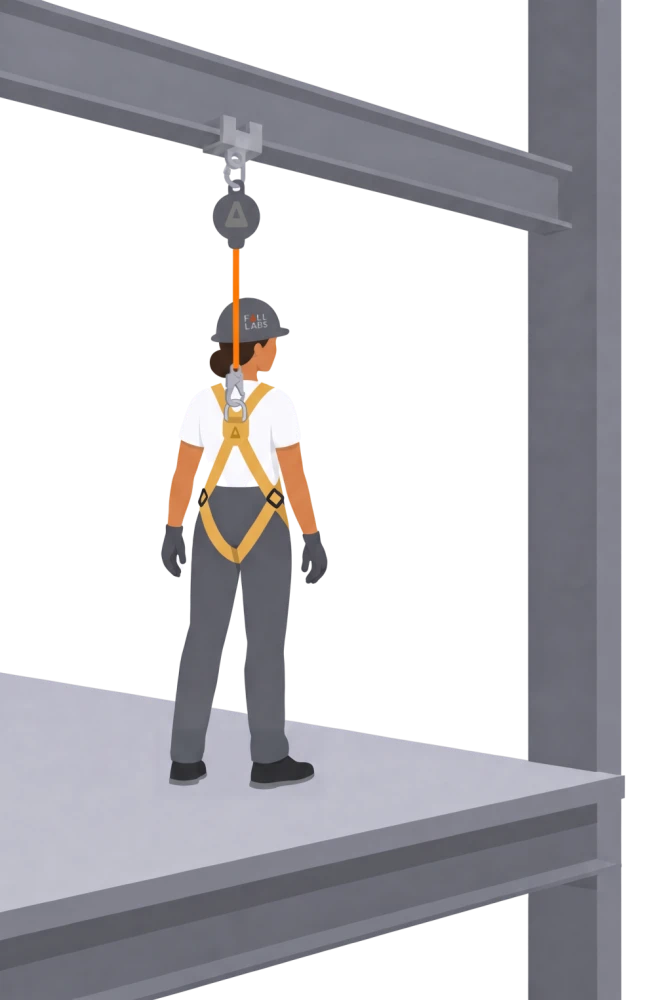
Ask what a fall protection anchor point has to hold and most crews answer without thinking: 5,000 pounds. The number comes straight from the Occupational Safety and Health Administration (OSHA), and it is the right place to start. OSHA’s word for an anchor point is anchorage, which it defines as a secure point of attachment for lifelines, lanyards, or deceleration devices, and every other part of a personal fall arrest system depends on it.
OSHA also allows a second, engineered way to qualify an anchorage, and that sometimes leads people to treat 5,000 pounds as optional, which it is not. Without a qualified person’s design, 5,000 pounds per worker is the requirement, and several common setups need more than that. One question comes before all of it, which is whether the fall hazard can be removed, guarded, or controlled with a restraint system that keeps the worker away from the fall hazard. Anchorage strength for fall arrest matters once fall arrest is the control.
What OSHA requires
In construction, OSHA’s anchorage rule in the Code of Federal Regulations (CFR), 29 CFR 1926.502(d)(15), requires anchorages for personal fall arrest equipment to be independent of any anchorage used to support or suspend platforms. It then gives two ways to meet the strength requirement. The anchorage can support at least 5,000 pounds (22.2 kN) per employee attached, or it can be designed, installed, and used as part of a complete personal fall arrest system that maintains a safety factor of at least two, under the supervision of a qualified person. General industry sets the same two paths at 1910.140(c)(13), with its independence requirement at 1910.140(c)(12). These are federal rules for the United States, and other countries set their own.
Where 5,000 pounds came from
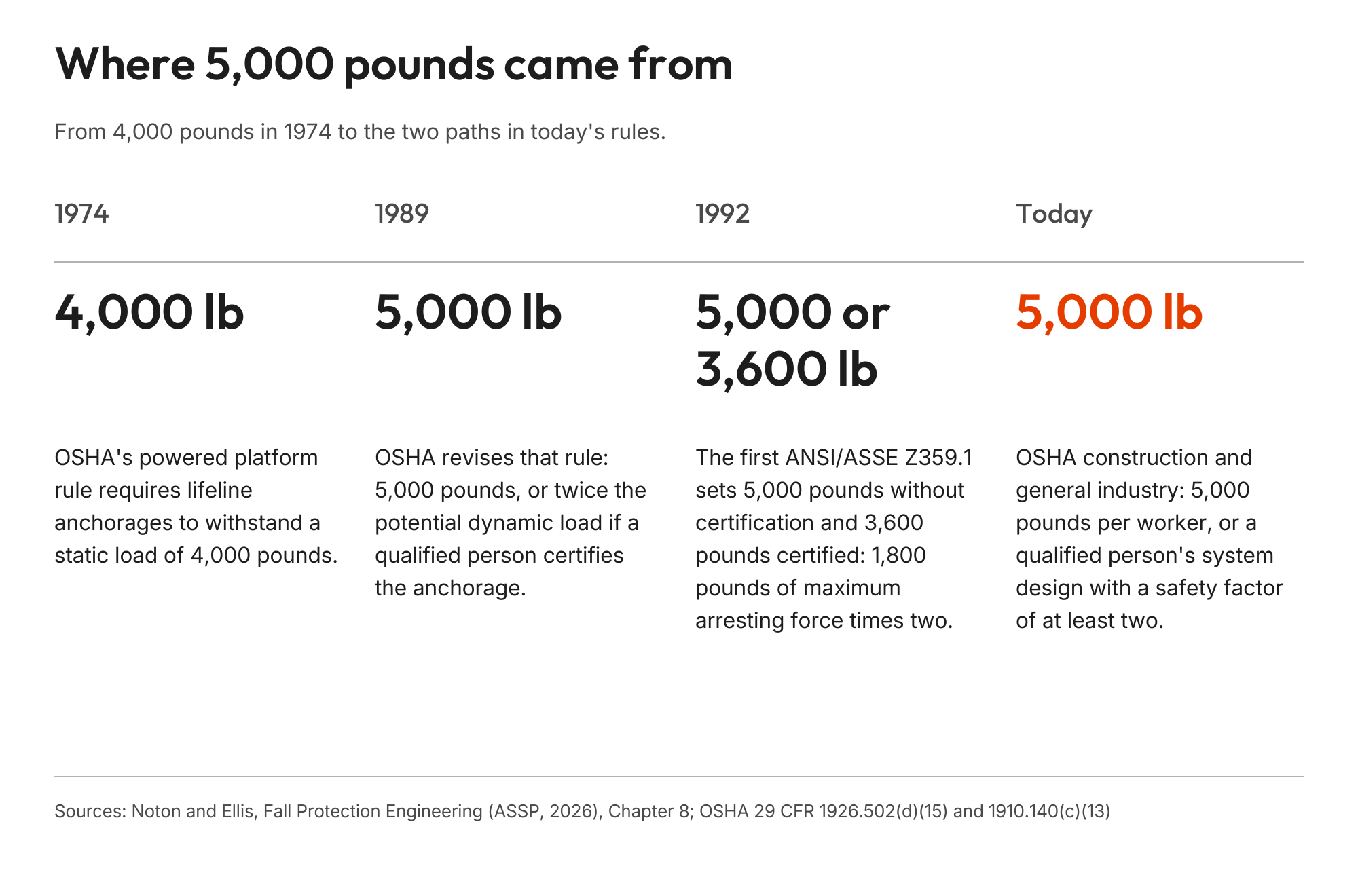
The 5,000-pound figure goes back to the late 1980s. By 1974, OSHA’s rule for powered platforms used in building maintenance required lifeline anchorages to withstand a static load of 4,000 pounds. In 1989 OSHA revised that rule and adopted a recommendation from the United States Technical Advisory Group (USTAG): anchorage strength of at least twice the potential dynamic load if a qualified person certified the anchorage, or 5,000 pounds if not. The first edition of ANSI/ASSE Z359.1, published in 1992, used the same two-part structure, 5,000 pounds for an anchorage without certification and 3,600 pounds for a certified one, which matches OSHA’s 1,800-pound maximum arresting force times a safety factor of two.
OSHA’s construction and general industry rules carry the same two paths today. The fixed path sets the required strength at 5,000 pounds per worker. The engineered path requires a qualified person’s system design with a safety factor of at least two. Either way, the anchorage’s capacity still has to be established.
Why 5,000 pounds is the number to aim for
The fixed path has one great advantage, which is that it does not depend on the equipment connected to it. OSHA limits the maximum arresting force on a worker in a full body harness to 1,800 pounds, so an anchorage good for 5,000 pounds carries a wide reserve with any compliant lanyard or self-retracting device connected directly to it. An engineered design load can be well below 5,000 pounds, which leaves less reserve if the equipment, the number of workers, or the direction of the load turns out to be different from what the design assumed.
Fall Labs recommends treating 5,000 pounds per worker as the target wherever the structure can provide it, for the same reason we recommend tying off as high as possible when there is a choice: more capacity is more safety margin.
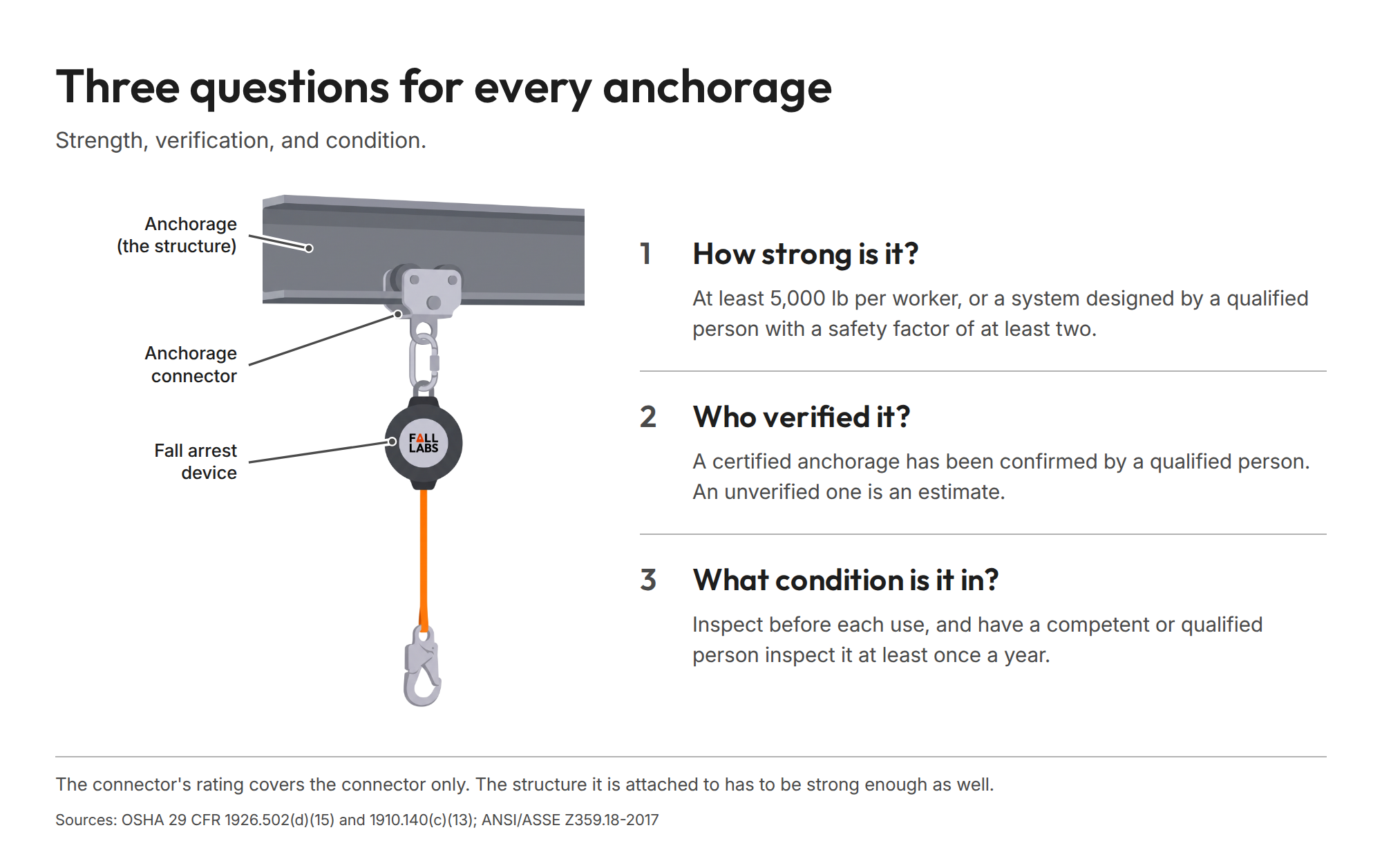
Capacity is only half of it. The ANSI/ASSP Z359 standards, which are published by the American Society of Safety Professionals (ASSP) and approved by the American National Standards Institute (ANSI), separate a certified anchorage, which a qualified person has certified as capable of supporting the loads it will see in use, from a non-certified anchorage, which is selected on an estimate that it can. A 5,000-pound anchorage that nobody has verified is still an estimate, and a certified anchorage is the higher level of assurance. The best anchorage has both: the capacity, and a qualified person’s confirmation that the capacity is really there.
Two details of the 5,000-pound path
- It is per worker. The rule reads “per employee attached,” so two workers on one anchorage need 10,000 pounds. OSHA uses the same arithmetic for the one case where two workers may share a vertical lifeline, in an elevator shaft under construction: “10,000 pounds [5,000 pounds per employee attached].”
- It has to be independent. An anchorage that is also holding up the platform the worker is standing on does not qualify.
The engineered path belongs to a qualified person
The second path replaces the fixed number with a calculated one, and OSHA attaches two conditions to it. The anchorage has to be part of a complete personal fall arrest system with a safety factor of at least two, and that system has to be designed, installed, and used under the supervision of a qualified person. OSHA defines qualified as someone who, by a recognized degree, certificate, or professional standing, or by extensive knowledge, training, and experience, has successfully demonstrated the ability to solve problems relating to the subject matter, the work, or the project.
In the 2011 interpretation OSHA described the engineered basis as two times the maximum fall arresting force of the system. For a single worker connected directly to the anchorage, with arresting force capped at 1,800 pounds, that works out to 3,600 pounds at most, and less where the system arrests a fall at a lower force. Where the system multiplies the load on the anchorage, as a horizontal lifeline does, the design load is higher. ANSI/ASSP Z359.6-2026, the standard for designing active fall protection systems, is built to deliver the same safety factor of at least two for certified anchorages.
This is how horizontal lifelines, rooftop systems, and many permanent anchorages are designed, and done properly it is every bit as sound as the fixed number. It is not a way for a crew to talk a doubtful anchor point into compliance. If no qualified person has designed and documented the system, the engineered path is not available, and 5,000 pounds per worker is the requirement.
When 5,000 pounds is not enough
- More than one worker. On the fixed-strength path, every additional person attached adds another 5,000 pounds to the requirement.
- Horizontal lifelines. Both OSHA rules require every horizontal lifeline to be designed, installed, and used under the supervision of a qualified person, with a safety factor of at least two. A lifeline pulled tight multiplies the force of a fall at its end anchorages. OSHA’s appendix guidance gives the example of about 2 to 1 at a 15-degree sag angle and about 6 to 1 at 5 degrees, and says strength should be increased for each additional worker tied off. That is why horizontal lifeline systems often include an energy absorber to hold the load down, and why sizing their anchorages is a qualified person’s calculation, not a field estimate.
- Rescue. A rescue can put more than one person on an anchorage, and a rescuer who is exposed to a fall needs an anchorage suitable for fall arrest. ANSI/ASSP Z359.4, the standard for rescue systems, sets a separate figure for a rescue-only anchorage (3,100 pounds, or a safety factor of 5 to 1 under a qualified person) and notes that an anchorage used for both fall arrest and rescue has to meet the greater load. Z359.6 has the qualified person set rescue anchorage strength from all of the static and dynamic loads expected.
- Equipment with its own rule. Some equipment carries a higher figure in the regulation itself. In general industry, the anchors fixed beside a window for a window cleaner’s positioning belt have to hold at least 6,000 pounds each. A window cleaner’s belt is part of a positioning system, which OSHA handles separately from the general anchorage rule.
Strength on day one is not strength today
Every figure above describes an anchorage in sound condition. Corrosion, weather, loosened fasteners, and damage to the structure can all reduce what an anchorage will hold, and an outdoor anchorage is exposed to them for years.
The Z359 standards treat that as both a design problem and an inspection problem. ANSI/ASSE Z359.18-2017, the standard for anchorage connectors, was published when ASSP was still the American Society of Safety Engineers (ASSE). It requires salt spray corrosion testing for connectors with load-bearing iron or steel parts that are not stainless or hot-dip galvanized, with a far longer exposure for the type intended for tie-back anchorages that serve outdoors for years. Z359.6 requires every component of a system to be specified for the environment it will work in, including corrosion, weather, and ultraviolet exposure, and it requires any part of an anchorage that will be permanently hidden from view to be made of materials durable enough for that environment. The reason is easy to see: a hidden part cannot be inspected later. Z359.6 also has the qualified person account for deterioration over the anchorage’s service life.
Inspection covers what design cannot. Z359.18 has the manufacturer’s instructions call for inspection by the user before each use and by a competent or qualified person other than the user at least once a year. When an inspection finds defects or damage, the connector comes out of service permanently or is repaired as the manufacturer directs.
A rated connector does not make a rated anchorage
The anchorage is the secure point of attachment. The anchorage connector is the component that couples the system to it, such as a beam strap, a beam clamp, or a bolted D-ring plate. Z359.18 requires its Type A and Type T connectors to resist a static load of 5,000 pounds and allows a lower figure for Type D connectors, which are designed to deform and absorb energy so that less load reaches the anchorage. It also requires the manufacturer’s instructions to state that the testing covers the connector only and does not extend to the anchorage it is attached to. A 5,000-pound strap around a member of unknown strength is only as strong as that member.
Where the anchorage is matters as much as what it holds
An anchorage can be strong enough and still be in the wrong place. Its height sets how far a worker falls before the system engages and how much clearance is needed below, and its position relative to the work sets the risk of a swing fall. Where the choice is between an overhead anchorage and one at the feet, overhead is always preferred, unless a competent person determines it would create other hazards. Our article on fall clearance shows how much the anchorage height changes the room needed below.
Putting it to work
- Aim for 5,000 pounds per worker attached wherever the structure can provide it, and have a competent or qualified person confirm it.
- Use the engineered path only with a qualified person’s documented design, and use the system the way it was designed.
- Count the workers on every anchorage.
- Treat every horizontal lifeline as an engineered system, because the rules do.
- Rate the structure, not just the connector.
- Tie off as high as possible, and as directly over the work as practical.
- Inspect the anchorage and its connector before each use, and have them inspected at least once a year.
- If you are not sure an anchor point will hold, do not tie off to it. Stop and ask a qualified person.
How to tell whether something counts as an anchor point in the first place is the subject of a separate article, What Counts as a Fall Protection Anchor Point?
Frequently asked questions
OSHA requires 5,000 pounds per employee attached, or an anchorage designed, installed, and used under a qualified person as part of a complete system with a safety factor of at least two. Fall Labs recommends aiming for 5,000 pounds per worker wherever the structure can provide it.
10,000 pounds on the fixed path, because the rule is 5,000 pounds per employee attached.
Only if that person also meets OSHA’s definition of a qualified person for the work. OSHA requires the engineered path to be under the supervision of a qualified person.
No. The connector’s rating covers the connector only. The structure it is attached to has to be strong enough as well.
Sources11
- OSHA 29 CFR 1926.502(d)(8), (d)(10)(ii), and (d)(15), horizontal lifelines, shared vertical lifelines, and anchorages (construction).
- OSHA 29 CFR 1910.140(b), (c)(11), (c)(12), (c)(13), and (e)(2)(iii), definitions, horizontal lifelines, anchorages, and window cleaners’ belt anchors (general industry).
- OSHA 29 CFR 1926.32(m) and 1926.500(b), definitions of qualified and anchorage.
- OSHA 29 CFR 1926.502(d)(16)(ii) and 1910.140(d)(1)(i), maximum arresting force.
- OSHA 29 CFR 1926 Subpart M, Appendix C, and 1910 Subpart I, Appendix C, horizontal lifeline loads and multiple users.
- OSHA Standard Interpretation, February 8, 2011, anchorage strength (construction).
- ANSI/ASSP Z359.0-2023, Definitions and Nomenclature Used for Fall Protection and Fall Arrest.
- ANSI/ASSP Z359.4-2013 (R2022), Safety Requirements for Assisted-Rescue and Self-Rescue Systems, Subsystems and Components.
- ANSI/ASSP Z359.6-2026, Specifications and Design Requirements for Active Fall Protection Systems.
- ANSI/ASSE Z359.18-2017, Safety Requirements for Anchorage Connectors for Active Fall Protection Systems.
- Rupert Noton and J. Nigel Ellis, Fall Protection Engineering (American Society of Safety Professionals, 2026), Chapter 8, Anchorages.
Last reviewed: October 2026.
This article is for general informational purposes only. It is not legal, medical, or engineering advice, and it does not replace hands-on training, a site-specific hazard assessment, or the judgment of a competent or qualified person. Always follow the manufacturer’s instructions for your equipment and the regulations that apply where you work, and check with the authority having jurisdiction when in doubt. Standards, regulations, and research cited here were current when this article was written and may since have been revised, reaffirmed, or withdrawn. Fall Labs makes no warranty as to the completeness or accuracy of this information and is not responsible for how it is used. References to OSHA, ANSI, the American Society of Safety Professionals, or any other organization do not imply their endorsement.