

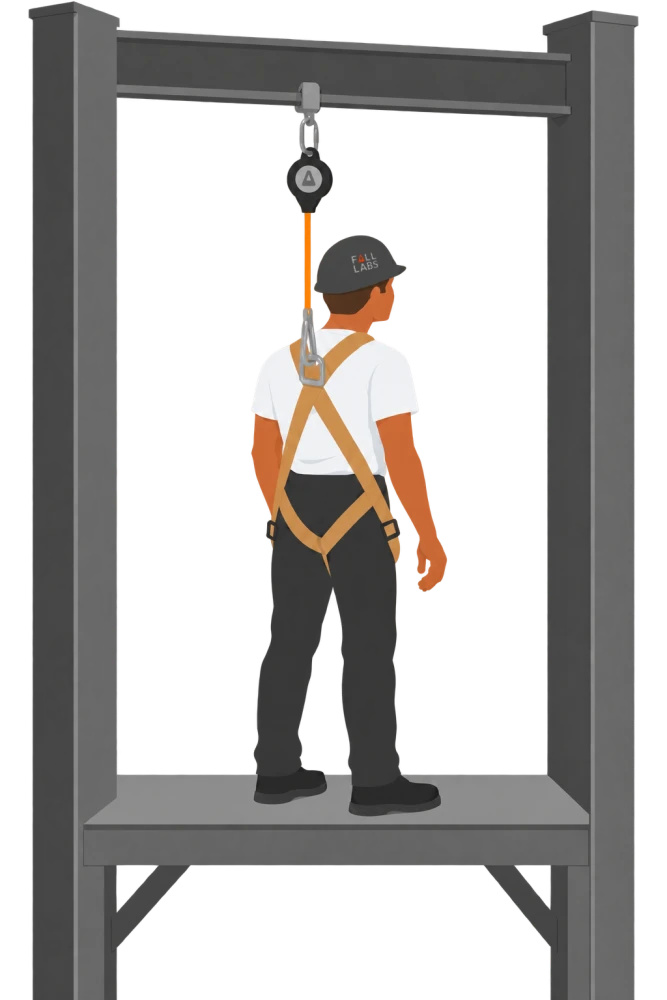
“Can I tie off to this?” is one of the most common questions in fall protection, and a wrong answer can stay hidden until the day the system is loaded. The Occupational Safety and Health Administration (OSHA) calls an anchor point an anchorage and defines it in one line: “a secure point of attachment for lifelines, lanyards or deceleration devices.” Everything starts with the word secure.
This article is about anchorages for personal fall arrest systems. Removing the hazard, guarding it, or using a restraint system that keeps the worker away from the edge all come first where they can be used, and when fall arrest is the control, the anchorage is what every other component depends on. It is the A in the ABCs of fall protection, and it comes first for a reason.
What OSHA requires of an anchorage
- Strength. In both construction and general industry, an anchorage has to support at least 5,000 pounds for each worker attached, or be designed, installed, and used under the supervision of a qualified person as part of a complete system that maintains a safety factor of at least two.
- Independence. It cannot be the same anchorage that supports or suspends the platform the worker is on.
- No guardrails or hoists. In construction, 29 CFR 1926.502(d)(23) says personal fall arrest systems “shall not be attached to guardrail systems, nor shall they be attached to hoists except as specified in other subparts of this part.”
Those are federal rules for the United States, and other countries set their own. OSHA sets the legal minimum. For the manufactured anchorage connector, ANSI/ASSE Z359.18-2017 goes further, with design and material requirements and tests for static strength, dynamic strength, residual strength, and corrosion resistance.
Three ways an anchor point is provided
Most anchor points on a jobsite come about in one of three ways, and they are not equally easy to trust.
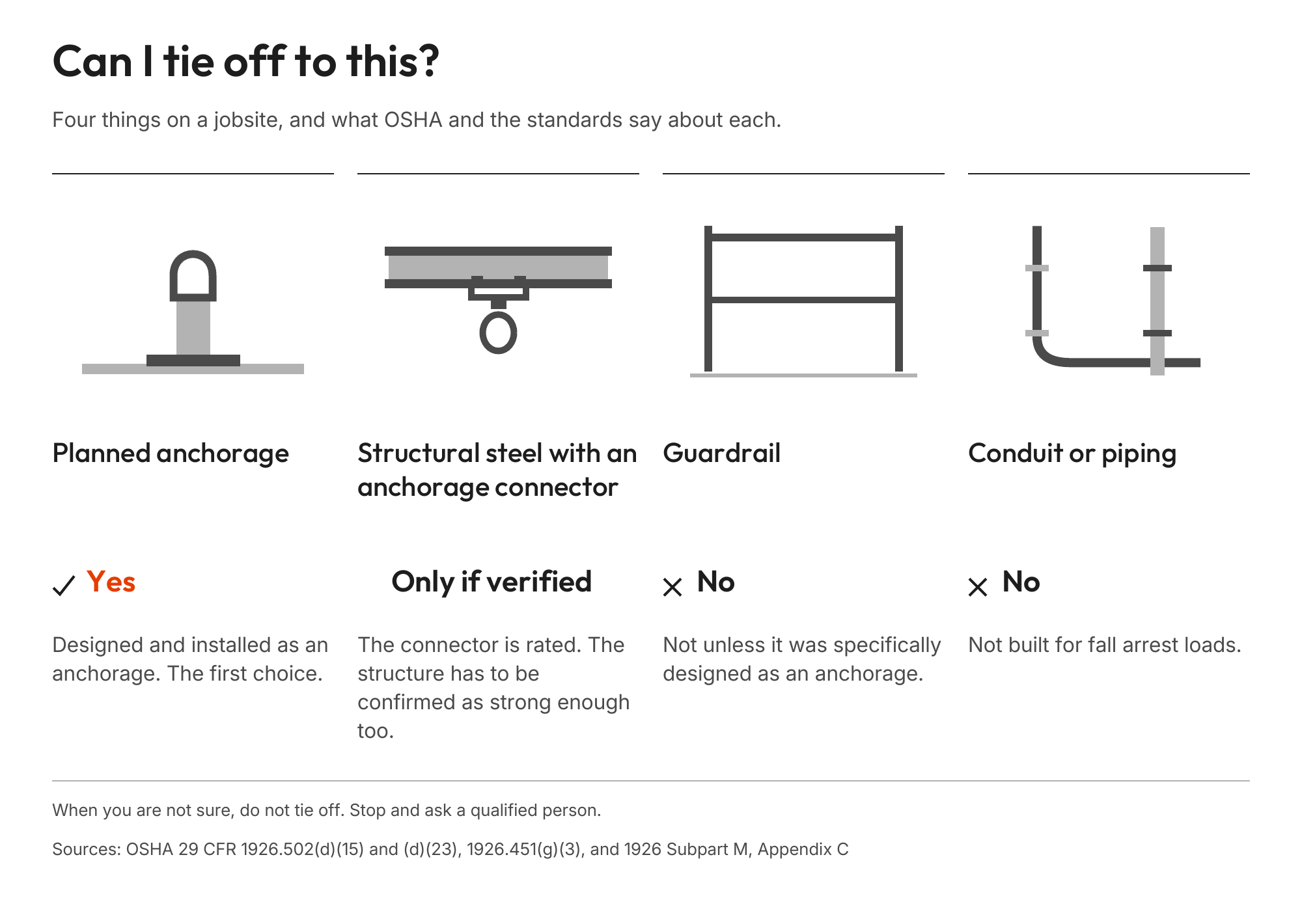
- Planned anchorages. These are designed and installed to be anchorages, often when the building or structure is built. OSHA’s guidance is direct: “Properly planned anchorages should be used if they are available.” The ANSI/ASSP Z359 standards, published by the American Society of Safety Professionals (ASSP) and approved by the American National Standards Institute (ANSI), call an anchorage certified when a qualified person has certified that it can support the loads it will see in use. This is the first choice.
- Structure fitted with an anchorage connector. An anchorage connector is not the anchorage, although the two terms are often used as if they meant the same thing. The anchorage is the structure. The anchorage connector, such as a beam clamp, a strap, a roof anchor, or a bolted D-ring plate, is the manufactured component that couples the system to that structure. ANSI/ASSE Z359.18-2017 sets the tests these connectors have to pass, and it requires the manufacturer’s instructions to state that the testing covers the connector only and does not extend to the structure it is attached to. The instructions also have to say what the connector may be attached to and what to do when the user cannot tell whether the structure qualifies.
- Existing structure. Sometimes an anchor point has to be found in what is already there. OSHA’s guidance for construction gives examples of what might be appropriate: steel members or I-beams where an acceptable strap is available for the connection, large eye-bolts made of an appropriate grade of steel, guardrails or railings only “if they have been designed for use as an anchor point,” and masonry or wood members only if the attachment point is substantial and bolts or other connectors cannot pull through. The same guidance says a qualified person should evaluate these anchorages, with a focus on proper strength. When existing structure is used, choose an anchorage connector that is compatible with it and designed by its manufacturer for that type of structure or material.
What does not count
- A guardrail or railing, unless it was specifically designed as an anchorage and meets the anchorage strength requirement. An ordinary guardrail is not built for fall arrest loads in any industry. A guardrail has its own OSHA strength criteria as a guardrail, which this article does not cover.
- A hoist, except where another OSHA rule specifically allows it, or the same anchorage that supports or suspends your work platform. Equipment-specific rules govern where you may tie off on aerial lifts, scaffolds, and cranes.
- A lanyard wrapped around a member and clipped back onto itself, unless the lanyard is designed for tie-back use and designated by its manufacturer for connection to that type of anchorage.
- An anchorage connector attached to a structure that has not been evaluated.
- Something installed for another purpose, such as conduit, piping, ductwork, a light fixture, or a handrail. None of these were designed for fall arrest loads. OSHA’s scaffold rule says outright that safe points of anchorage for a vertical lifeline “do not include standpipes, vents, other piping systems, electrical conduit, outrigger beams, or counterweights.” Fall Labs recommends not using anything in this group unless a qualified person has evaluated and approved it for the intended use and the applicable rule permits it.
- Anything chosen because it looks solid. Looking sturdy is not the same as supporting 5,000 pounds.
How you connect matters too
A sound anchorage can be undone by the way the system is attached to it. OSHA’s guidance lists several ways a connection loses strength:
- A knot in a rope lanyard or lifeline can reduce its strength by 50 percent or more.
- A rope lanyard or lifeline tied around an H-beam or I-beam can lose as much as 70 percent of its strength to the cutting action of the beam edges.
- A line that passes over rough or sharp surfaces loses strength drastically.
- An eye-bolt is rated along the axis of the bolt, and its strength is greatly reduced when the load comes at an angle.
That is why only equipment approved by its manufacturer for that kind of connection should be used: a lanyard or lifeline with its own connector, and an anchorage connector suited to the structure, used the way the manufacturer’s instructions say.
Where it is
A strong anchorage in the wrong place can still let a worker reach the level below or swing into an obstruction. Tie off as high as possible. Where the choice is between an overhead anchorage and one at the feet, overhead is always preferred, unless a competent person determines it would create other hazards. Keep the anchorage as directly above the work as practical to limit swing, and confirm there is enough clearance below, which our article on fall clearance explains.
Take the environment into account as well. OSHA’s guidance says to evaluate the work environment before choosing a system, including heat, cold, moisture, chemicals, and operations such as welding that can damage lanyards, connectors, and lifelines.
Who makes the call
Identifying anchorages is the employer’s job, carried out through people with the knowledge and authority to do it. OSHA puts the engineered path under the supervision of a qualified person and recommends a qualified person evaluate anchorages improvised from existing structure. The Z359 standards separate a certified anchorage, which a qualified person has certified, from a non-certified anchorage, which has been selected on an estimate that it can support the load. The worker’s part is to use the anchorages that have been identified, inspect them before use, and speak up when something looks wrong.
When you are not sure whether something will hold, do not tie off to it. Stop and ask for a qualified person to assess it. It is far better to be cautious than to assume, because an assumption about an anchor point is only tested when someone falls.
Most people have heard that a chain is only as strong as its weakest link. A fall arrest system works the same way: an appropriate full body harness and connector cannot make up for an anchorage that will not hold.
Before you tie off
- Has this been identified as an anchorage by a competent or qualified person, or designed as one?
- Can it support 5,000 pounds for each worker attached, or has a qualified person designed the system?
- Is it independent of the anchorage that supports the work platform?
- Is the anchorage connector compatible with it and used according to the manufacturer’s instructions?
- Is it at or above the D-ring, close to directly overhead, with enough clearance below?
- Is it in sound condition, free of visible corrosion, cracks, deformation, and loose hardware?
- If the answer to any of these is no or unknown, stop and ask.
Choosing and installing anchorage connectors on steel, concrete, and wood will be covered in future articles.
Frequently asked questions
OSHA calls it an anchorage: a secure point of attachment for lifelines, lanyards, or deceleration devices.
No, unless it was specifically designed as an anchorage and meets the anchorage strength requirement. OSHA’s construction rule prohibits attaching personal fall arrest systems to guardrail systems, and in any industry an ordinary guardrail is not built for fall arrest loads.
At least 5,000 pounds for each worker attached, or designed, installed, and used under a qualified person as part of a complete system with a safety factor of at least two.
The employer, through a competent or qualified person. OSHA recommends a qualified person evaluate anchorages improvised from existing structure.
Sources7
- OSHA 29 CFR 1926.500(b) and 1910.140(b), definitions of anchorage and qualified.
- OSHA 29 CFR 1926.502(b)(3), (d)(15), and (d)(23), guardrail strength criteria, anchorages, and attachment to guardrail systems and hoists (construction).
- OSHA 29 CFR 1910.140(c)(12) and (c)(13), anchorages (general industry).
- OSHA 29 CFR 1926.451(g)(3), personal fall arrest systems on scaffolds and safe points of anchorage.
- OSHA 29 CFR 1926 Subpart M, Appendix C, tie-off considerations.
- ANSI/ASSP Z359.0-2023, Definitions and Nomenclature Used for Fall Protection and Fall Arrest.
- ANSI/ASSE Z359.18-2017, Safety Requirements for Anchorage Connectors for Active Fall Protection Systems.
Last reviewed: October 2026.
This article is for general informational purposes only. It is not legal, medical, or engineering advice, and it does not replace hands-on training, a site-specific hazard assessment, or the judgment of a competent or qualified person. Always follow the manufacturer’s instructions for your equipment and the regulations that apply where you work, and check with the authority having jurisdiction when in doubt. Standards, regulations, and research cited here were current when this article was written and may since have been revised, reaffirmed, or withdrawn. Fall Labs makes no warranty as to the completeness or accuracy of this information and is not responsible for how it is used. References to OSHA, ANSI, the American Society of Safety Professionals, or any other organization do not imply their endorsement.