

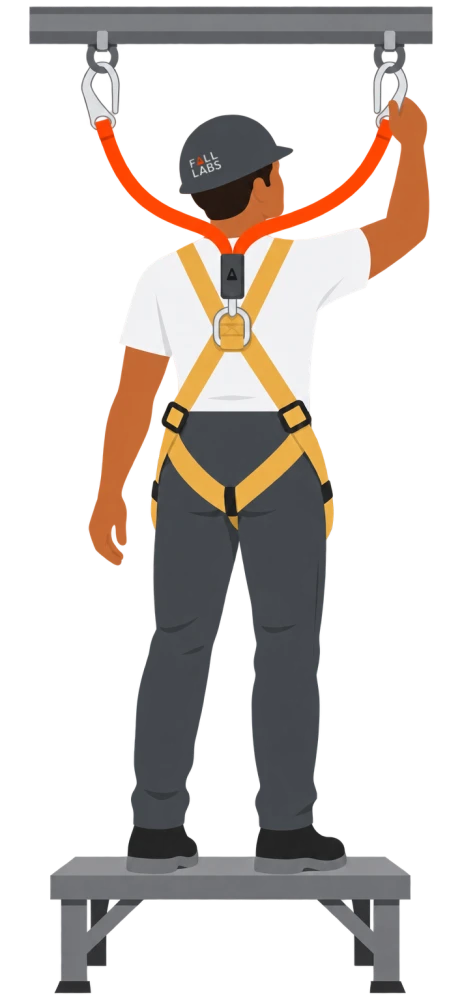
A worker moving along a beam, up a structure, or around an obstruction eventually reaches a point where the lanyard has to come off one anchorage and go onto the next. With a single lanyard, that moment leaves the worker unprotected. A twin-leg lanyard (sometimes called a double-leg, dual-leg, or Y-lanyard) closes that gap: the worker clips the free leg to the next anchorage before releasing the first, so they are never disconnected.
That practice is usually called 100% tie-off. Where the fall hazard cannot be designed out or guarded and workers depend on personal fall arrest, how the two legs are connected, moved, and stored decides whether the lanyard performs the way it was tested.
What 100% tie-off means
100% tie-off is an industry term for staying connected to a suitable anchorage the entire time a worker is exposed to a fall, including while moving. The phrase does not appear in the fall protection regulations of the Occupational Safety and Health Administration (OSHA), but it follows from how they are written. In general industry, 29 CFR 1910.28(b)(1)(i) requires employees on a walking-working surface with an unprotected side or edge 4 feet (1.2 m) or more above a lower level to be protected from falling. In construction, 29 CFR 1926.501(b)(1) sets the same duty at 6 feet (1.8 m). Other provisions set different thresholds for some work, such as steel erection, and neither rule makes an exception for the time spent moving between anchorages.
In a 2017 interpretation about climbing fixed ladders in general industry, OSHA said that a full body harness, double lanyards, and an anchorage used to keep a 100% connection meet the definition of a personal fall arrest system, provided the components meet 1910.140(c) and (d), including a 5,000-pound (22.2 kN) minimum for the lanyards and for each anchorage per employee attached. This article covers the United States, and other countries set their own rules.
How a twin-leg lanyard is built and tested
A twin-leg lanyard has two legs joined at a central connector that attaches to the harness, usually at the dorsal D-ring. Designs vary: some use one energy absorber at the harness end for both legs, and others put an absorber in each leg. The consensus standard for this equipment is ANSI/ASSP Z359.13-2013 (R2022), Personal Energy Absorbers and Energy Absorbing Lanyards, an American National Standards Institute (ANSI) standard published by the American Society of Safety Professionals (ASSP). It sets additional tests for twin-leg lanyards, which it calls Y-lanyards.
Each leg has to meet the same performance limits as a single energy absorbing lanyard. For a 6-foot free fall lanyard tested under dry, room-temperature conditions, that means an average arrest force of no more than 900 pounds (4 kN), a deployment of no more than 48 inches (1.2 m), and a peak of no more than 1,800 pounds (8 kN). A 12-foot free fall lanyard is allowed a higher average force and more deployment but the same 1,800-pound peak. Wet, cold, and hot test conditions allow a somewhat higher average, but never a higher peak. The standard also pull-tests the lanyard in three configurations to at least 5,000 pounds (22.2 kN). Check the label for which type you have, because the free fall rating affects both how the lanyard can be rigged and how much clearance it needs.
Making the move
Connect the free leg to the next anchorage, confirm the gate is closed and locked, and only then release the leg behind you. Each anchorage has to be suitable for fall arrest. Under 1926.502(d)(15) in construction and 1910.140(c)(13) in general industry, an anchorage for personal fall arrest equipment must support at least 5,000 pounds (22.2 kN) per employee attached, or be designed, installed, and used under the supervision of a qualified person as part of a complete system with a safety factor of at least two.
The connections need the same care as the anchorages. Under 1926.502(d)(5) and 1910.140(c)(9), snaphooks must be the locking type, and under 1926.502(d)(6) and 1910.140(c)(10), connectors may not be clipped to each other, or to a D-ring that already has another connector on it, unless they are designed for that connection. The lanyard manufacturer’s instructions say which connections a given lanyard is designed for.
When both legs are attached
Every move includes a moment when both legs are on, and sometimes both end up on the same anchorage. Z359.13 drop-tests every twin-leg lanyard with both legs attached to the same point, and the peak force must stay at or below 1,800 pounds (8 kN). Whether both legs may stay on one anchorage, and on one anchorage connector, is a question for the manufacturer’s instructions and, where the anchorage is a D-ring, for the OSHA connection rules above.
Where the unused leg goes
Between moves, one leg is usually free, and where it is stored matters. Many workers stow it on a hip D-ring. If that leg goes taut in a fall, it can pull on the harness from the side instead of through the dorsal D-ring. Z359.13 checks for this with a hip test in which the unused leg is fastened to the side of the test weight with a nylon cable tie. A lanyard that breaks the tie in that test must carry a warning label on each leg that tells users how to store the free leg safely.
The harness standard addresses it from the other side. ANSI/ASSP Z359.11-2021 requires every full body harness built to it to have at least one labeled lanyard parking attachment that releases at no more than 120 pounds (0.5 kN), generally located on the chest. Its required user instructions caution against storing an unused leg on the hip attachments or any other rigid point on the harness, and say it should go on a positioning or other structural element only with approval from both the competent person and the lanyard manufacturer. Depending on the lanyard’s design, a stored leg that cannot release may carry part of the fall’s load into the harness by the wrong path, which can keep the energy absorber from working as intended. That kind of loading through the unused leg is what the harness standard’s user guidance warns about, and it is why the parking attachment is designed to let go at a low force. Our recommendation is to store the free leg on the harness’s parking attachment, or where the lanyard manufacturer directs, and not on a hip D-ring.
Configurations to avoid
Some misuse is tempting because it seems to add reach. Connecting one leg to the harness and the other to the anchorage, instead of using the central connector, can nearly double the connecting length and with it the potential free fall, well beyond what the lanyard and the clearance calculation assume. Z359.13 includes this leg-to-leg arrangement in its static strength test because it happens in the field, not because it is an approved way to rig. Wrapping a leg around a beam and hooking it back onto itself is another, and it is acceptable only on a lanyard designed and labeled for tie-back use.
When another system suits the job better
A twin-leg energy absorbing lanyard needs clearance below the working surface for the free fall, the absorber’s deployment, and harness stretch, and it adds a connection step every time the worker moves. Where clearance is limited or moves are frequent, a self-retracting device, a twin-leg self-retracting device, or an engineered horizontal lifeline may be a better choice, and where a lifeline could contact an edge, the device must be rated for that use. The right choice depends on the hazard assessment, the available anchorages, and the clearance below, and the goal does not change: a worker who stays connected to something that will hold for the entire time they are exposed.
Choosing between 6-foot and 12-foot free fall lanyards, and working out the clearance each one needs, will come up in future articles.
References
- OSHA 29 CFR 1910.28(b)(1)(i), duty to protect from falls (general industry).
- OSHA 29 CFR 1926.501(b)(1), duty to protect from falls (construction).
- OSHA 29 CFR 1926.502(d)(5), (d)(6), and (d)(15), snaphook type and connections and anchorage strength (construction).
- OSHA 29 CFR 1910.140(c)(9), (c)(10), and (c)(13), snaphook and carabiner type and connections and anchorage strength (general industry).
- OSHA Standard Interpretation, June 22, 2017, double lanyards for 100% connection on fixed ladders under 1910.28(b)(9).
- ANSI/ASSP Z359.13-2013 (R2022), Personal Energy Absorbers and Energy Absorbing Lanyards.
- ANSI/ASSP Z359.11-2021, Safety Requirements for Full Body Harnesses.
Last reviewed: September 2026.
This article is for general informational purposes only. It is not legal, medical, or engineering advice, and it does not replace hands-on training, a site-specific hazard assessment, or the judgment of a competent or qualified person. Always follow the manufacturer’s instructions for your equipment and the regulations that apply where you work, and check with the authority having jurisdiction when in doubt. Standards, regulations, and research cited here were current when this article was written and may since have been revised, reaffirmed, or withdrawn. Fall Labs makes no warranty as to the completeness or accuracy of this information and is not responsible for how it is used. References to OSHA, ANSI, ASSP, or any other organization do not imply their endorsement.