

The short answer comes from the Occupational Safety and Health Administration (OSHA): “OSHA requires that fall protection be provided at elevations of four feet in general industry workplaces, five feet in shipyards, six feet in the construction industry and eight feet in longshoring operations.” The agency adds that fall protection is required “when working over dangerous equipment and machinery, regardless of the fall distance.”
The longer answer is that those four figures are the general rules. Scaffolds, steel erection, and fixed ladders each have a figure of their own, some work requires protection at any height, and each number marks the height at which the law starts to require fall protection, not a height below which a fall is safe. It helps to know which rule covers your work, and it helps just as much to know what the number does not tell you.
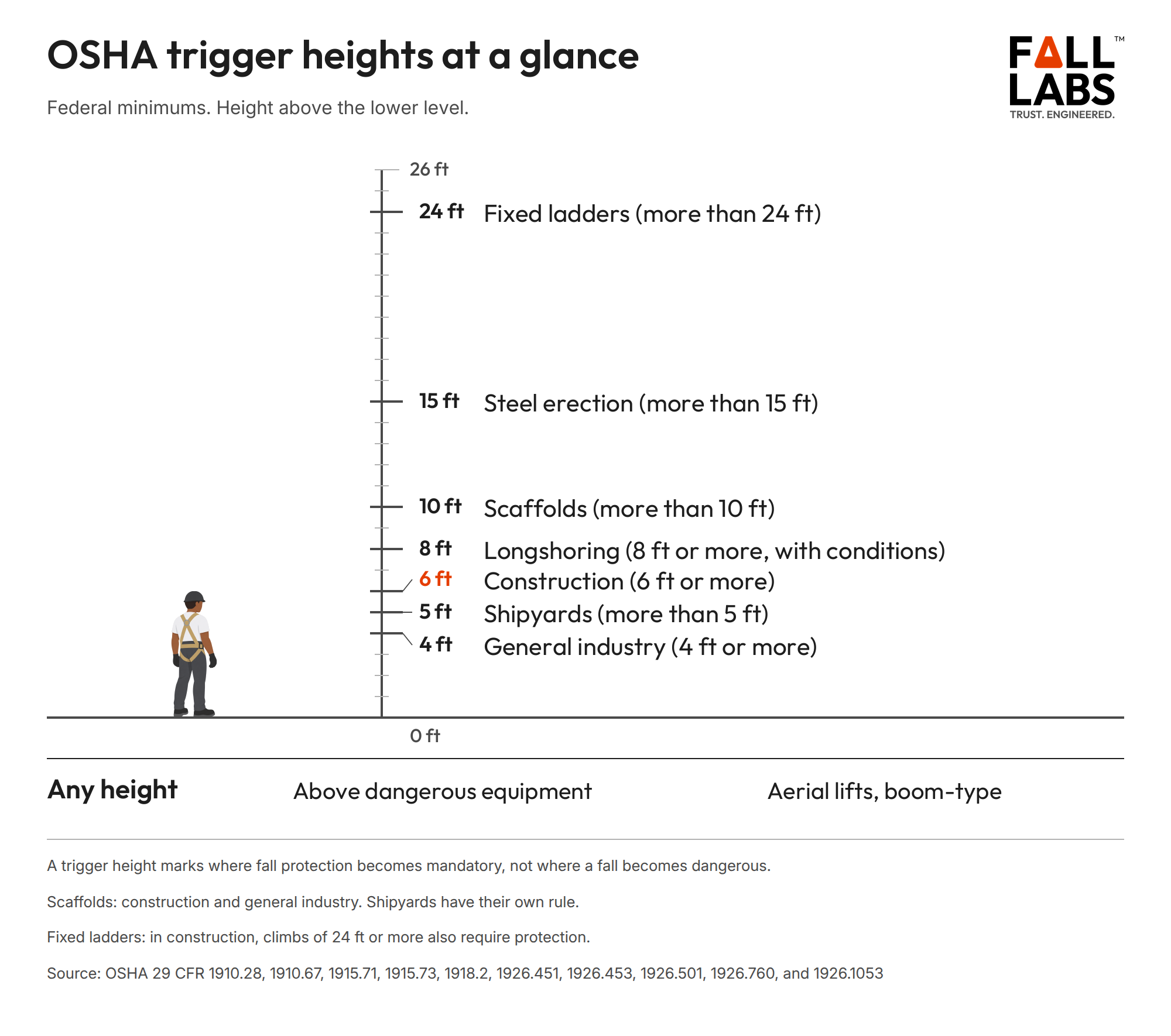
OSHA trigger heights at a glance
These heights are often called “trigger heights,” because reaching one triggers the employer’s duty to protect the worker. The table lists the federal figures and where each one is found.
| Work | Fall protection required at | OSHA rule |
|---|---|---|
| General industry | 4 feet or more above a lower level | 29 CFR 1910.28(b)(1) |
| Shipyards | More than 5 feet above a solid surface | 29 CFR 1915.73(d) |
| Construction | 6 feet or more above a lower level | 29 CFR 1926.501(b) |
| Longshoring | 8 feet or more, with conditions | 29 CFR 1918.2 |
| Scaffolds | More than 10 feet (construction and general industry) | 29 CFR 1926.451(g)(1) |
| Steel erection | More than 15 feet, with rules for connectors and deckers up to 30 feet | 29 CFR 1926.760 |
| Fixed ladders | More than 24 feet above a lower level. Construction also covers climbs of 24 feet or more | 29 CFR 1910.28(b)(9) and 1926.1053(a)(18) and (a)(19) |
| Above dangerous equipment | Any height | 29 CFR 1910.28(b)(6) and 1926.501(b)(8) |
| Aerial lifts (vehicle-mounted, boom-type) | Any height, attached to the boom or basket | 29 CFR 1910.67(c)(2)(v) and 1926.453(b)(2)(v) |
This article covers federal rules in the United States. States that run their own OSHA-approved State Plans must be at least as effective as federal OSHA, so check whether your state has one and what its rules say. Other countries set their own heights.
Reading the numbers
- The height is measured to the lower level, and OSHA’s construction definition of lower levels takes in more than the ground: floors, platforms, ramps, excavations, pits, tanks, materials, water, and equipment all count.
- In construction, 6 feet appears throughout the rule. It applies to unprotected sides and edges, leading edges, hoist areas, formwork and reinforcing steel, excavations, roofs, residential construction, and wall openings, each with its own conditions. Holes are worded differently: fall protection applies more than 6 feet above lower levels.
- Scaffolds follow the scaffold rule. In construction and general industry, a worker on a scaffold more than 10 feet above a lower level must be protected, because the general industry rule sends scaffold work to the construction scaffold standard. Shipyards have a scaffold rule of their own, which requires railings more than 5 feet above a solid surface or at any distance above the water.
- The longshoring figure comes with conditions. OSHA’s longshoring rules define a fall hazard as working within 3 feet of the unprotected edge of a work surface that is 8 feet or more above the adjoining surface and 12 inches or more, horizontally, from the adjacent surface. They also treat weather that may impair vision or sound footing on top of containers as a fall hazard. The duty to protect is set in the rules for each operation, such as hatch sections and stowed cargo, and work on containers.
- Steel erection has its own subpart. Protection is required above 15 feet. Connectors working between 15 and 30 feet must be provided with a personal fall arrest system, positioning device system, or fall restraint system and wear the equipment needed to tie off, or be given other protection, and they must be protected above two stories or 30 feet, whichever is less.
- Fixed ladders are in transition. In general industry, a fixed ladder that extends more than 24 feet above a lower level must have a personal fall arrest system, a ladder safety system, a cage, or a well if it was installed before November 19, 2018. Ladders installed since then need a personal fall arrest system or ladder safety system, and on and after November 18, 2036, every fixed ladder over that height does. The measurement is to the lower level, not the length of the ladder.
- Portable ladders have no trigger height. The general industry fall protection section does not apply to portable ladders, and the construction ladder standard does not require a worker on one to tie off. That does not make a fall from a ladder harmless. Fall Labs recommends fall protection whenever there is a risk of a fall that could cause injury, on a ladder or anywhere else.
- Some hazards have no height at all. A worker above dangerous equipment must be protected from falling onto it at any height. Below the trigger height, 4 feet in general industry and 6 feet in construction, the equipment can be covered or guarded instead, and in construction a guardrail also works. At or above the trigger height, fall protection is required whether or not the equipment is guarded. In construction, every hole a worker could trip in or step into must also be covered, and the cover has to meet OSHA’s rules: strong enough to support at least twice the load that may be put on it, secured so it cannot shift, and color coded or marked “HOLE” or “COVER.”
- Aerial lift means a vehicle-mounted, boom-type device in these rules. Scissor lifts are not covered by the two aerial lift paragraphs in the table.
- Some tasks have lower thresholds of their own. In construction, for example, a stairway with four or more risers or a rise of more than 30 inches, whichever is less, needs a handrail and a stair rail along each unprotected side.
A trigger height is a minimum
A trigger height tells an employer when fall protection becomes a legal duty. It does not say that a fall from just below it is safe. A highway speed limit works the same way. A sign that reads 65 miles per hour marks where the law draws its line on a clear, dry day, and nobody treats it as the right speed in snow, heavy rain, or fog, when conditions and judgment decide what is safe.
The same reasoning applies to work at height. A worker on a fixed ladder that tops out 20 feet above the lower level is under the 24-foot figure and a construction worker at 5 feet is under the 6-foot one, and neither is protected by being below the number. OSHA’s own rules show the principle, because they require protection over dangerous equipment at any height. What matters is what happens if you fall, and the height is only part of that.
ANSI/ASSP Z359.1-2024, the Fall Protection Code published by the American Society of Safety Professionals (ASSP) and approved by the American National Standards Institute (ANSI), points the same way. In a note on program design it describes a fall hazard hierarchy of controls: prevent or eliminate the exposure first, then use passive fall protection such as guardrails, then active systems, with travel restraint ahead of fall arrest. That order is as useful at 5 feet as it is at 50.
Fall Labs recommends using fall protection wherever a fall could injure someone, whether or not a trigger height has been reached. If you feel unsafe at any height, say so, and ask your employer or a competent person for a way to do the work that protects you. Being under the number is not a reason to go without.
Low heights need the right kind of protection
There is a practical catch below the trigger heights and just above them. A personal fall arrest system needs room to work, and a short fall may not give it any. In the worked examples in our article on fall clearance, a 6-foot energy absorbing lanyard anchored at D-ring height needs 13.5 feet of clearance below the working surface, and a self-retracting device anchored directly overhead needs 7 feet. A worker 6 or 10 feet up on that lanyard could reach the ground before the system finished stopping the fall.
That is why protection at low heights usually means something other than a harness and a lanyard: a guardrail, a cover over a hole, a travel restraint system that keeps the worker from reaching the edge, or a self-retracting device anchored overhead whose instructions confirm it can stop the fall in the room available. Guardrails, covers, and travel restraint also sit higher in the hierarchy than fall arrest, which is one more reason to reach for them first.
Finding the rule that applies to you
- Identify which OSHA standard covers the work: general industry, construction, shipyards, or longshoring.
- Check for a rule specific to the task, such as scaffolds, steel erection, ladders, aerial lifts, or dangerous equipment.
- Measure from the surface you are standing on to the lower level, including pits, equipment, and anything else you could land on.
- Check whether your state runs its own State Plan.
- Then ask the better question: could a fall here injure someone, and what is the best way to prevent it?
When the answer is not clear, ask your employer’s competent person before the work starts.
Which system to use once protection is needed, and how restraint, fall arrest, and positioning differ, is covered in a separate article.
Frequently asked questions
Four feet in general industry, five feet in shipyards, six feet in construction, and eight feet in longshoring, with separate figures for scaffolds in construction and general industry (more than 10 feet), steel erection (more than 15 feet), and fixed ladders (more than 24 feet above a lower level, and in construction also climbs of 24 feet or more).
OSHA’s general industry fall protection section does not apply to portable ladders, and the construction ladder standard does not require a worker on one to tie off.
OSHA requires it at any height above dangerous equipment, and holes must be covered at any height. Fall Labs recommends protection wherever a fall could injure someone, whether or not a trigger height has been reached.
Often not. A 6-foot energy absorbing lanyard anchored at D-ring height needs about 13.5 feet of clearance in our worked example, so low heights usually call for guardrails, restraint, or an overhead self-retracting device.
Sources13
- OSHA, Fall Protection, Overview, osha.gov/fall-protection.
- OSHA 29 CFR 1910.28(a)(2), (b)(1), (b)(6), (b)(9), and (b)(12), duty to have fall protection and falling object protection (general industry).
- OSHA 29 CFR 1926.500(a)(2) and (b), 1926.501(b), and 1926.502(i), scope, definitions, duty to have fall protection, and covers (construction).
- OSHA 29 CFR 1926.451(g)(1), fall protection on scaffolds.
- OSHA 29 CFR 1915.73(d), guarding of deck edges in shipyard employment.
- OSHA 29 CFR 1915.71(j), scaffold railings in shipyard employment.
- OSHA 29 CFR 1918.2, 1918.32(b), and 1918.85(j), definition of fall hazard and fall protection in longshoring.
- OSHA 29 CFR 1926.1052(c)(1), stair rails and handrails (construction).
- OSHA 29 CFR 1926.760(a) and (b), fall protection in steel erection.
- OSHA 29 CFR 1926.1053(a)(18) and (a)(19), fixed ladders (construction).
- OSHA 29 CFR 1910.67(c)(2)(v) and 1926.453(b)(2)(v), aerial lifts.
- OSHA, State Plans, osha.gov/stateplans.
- ANSI/ASSP Z359.1-2024, The Fall Protection Code.
Last reviewed: October 2026.
This article is for general informational purposes only. It is not legal, medical, or engineering advice, and it does not replace hands-on training, a site-specific hazard assessment, or the judgment of a competent or qualified person. Always follow the manufacturer’s instructions for your equipment and the regulations that apply where you work, and check with the authority having jurisdiction when in doubt. Standards, regulations, and research cited here were current when this article was written and may since have been revised, reaffirmed, or withdrawn. Fall Labs makes no warranty as to the completeness or accuracy of this information and is not responsible for how it is used. References to OSHA, ANSI, the American Society of Safety Professionals, or any other organization do not imply their endorsement.