

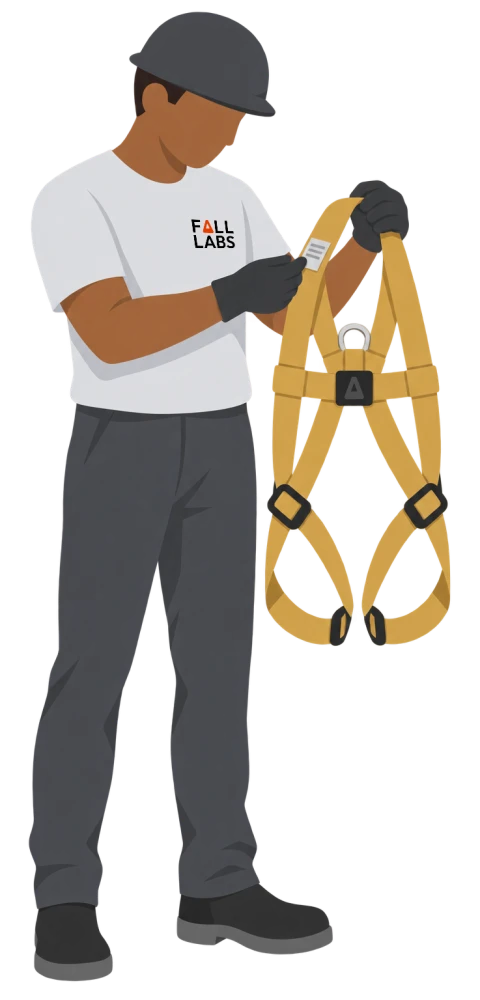
Every crew has the harness that has lived in the truck for years and still looks fine. Eventually someone asks the reasonable question: does it expire, and do I have to throw it out? A quick look is not the test, and the answer depends on three things: what the manufacturer’s instructions say, what inspection finds, and what has happened to that harness.
Do safety harnesses expire?
Not under federal regulation or the harness standard, though some do under their manufacturer’s instructions. The Occupational Safety and Health Administration (OSHA) sets no expiration date for a full body harness, and ANSI/ASSP Z359.11-2021, the consensus standard for full body harnesses, requires the month and year of manufacture on the label but no expiration date. Some manufacturers do set a maximum service life or replacement interval, and where yours does, that limit applies to your harness.
That makes the manufacturer’s instructions the first place to look. Z359.11 requires every harness to ship with them and says users shall, at a minimum, follow them for inspection, maintenance, and storage. Read the instructions for the harness you own rather than relying on a number you heard about someone else’s, including the five-year figure that neither OSHA nor Z359.11 sets.
This article covers the United States. Elsewhere the rules differ: in Europe, for example, manufacturers are required to state a lifespan or obsolescence period for their equipment where one applies, and some set a ten-year maximum for textile products.
Whatever the instructions say about age, a limit is a ceiling, not a guarantee. Two identical harnesses can have very different useful lives. One stored clean, dry, and out of the light can often stay serviceable for years, while one worked hard outdoors, in the sun and around concrete, can fail inspection within weeks. Within any limit the manufacturer sets, inspection and the harness’s history decide whether it is still fit for service.
What does the date on the label mean?
The date on the label records when the harness was made, not when it has to come out. Z359.11 requires every full body harness to be marked with, among other things, the month and year of manufacture, the manufacturer’s name or logo, the part number or model, and an identifying number unique to that harness. Together they tell you what the harness is, who made it, and when, which lets you check it against the manufacturer’s instructions and trace it if a question ever comes up.
If those markings are missing or unreadable, the harness comes out of service. Absence or illegibility of markings is the first item on the Z359.11 inspection list, and without those markings you cannot confirm what the harness is, who made it, or when it was built.
What does inspection look for?
You inspect it before every use, and at least once a year a competent person other than you inspects it too. Z359.11 requires the manufacturer’s instructions to set out that two-level inspection, and OSHA requires inspection before each use in construction and before initial use during each workshift in general industry, with defective components removed from service. The Z359.11 inspection looks for:
- Absence or illegibility of markings.
- Missing elements that affect the harness’s form, fit, or function.
- Hardware damage, including cracks, sharp edges, deformation, corrosion, chemical attack, excessive heating, alteration, and excessive wear.
- Webbing damage, including fraying, broken or pulled stitches, knotting, excessive elongation, chemical attack, excessive soiling, abrasion, alteration, excessive aging, and excessive wear.
The standard’s full list is longer, and it is a minimum. Your organization’s inspection criteria must equal or exceed the standard or the manufacturer’s instructions, whichever is greater. When an inspection finds a defect or damage, the harness is permanently removed from service or repaired by the original manufacturer or its designate before it goes back into use, and only the manufacturer, or someone it authorizes in writing, may make those repairs.
When in doubt, take it out. A clean-looking harness does not settle an unknown history. If you cannot rule out a fall, impact loading, or exposure to chemicals or heat, our recommendation is to remove the harness from service and ask the manufacturer before it is used again. Z359.11 likewise requires the instructions to tell users to consult the manufacturer when in doubt about exposure to chemicals, heat, or other harmful conditions.
Does a harness have to be replaced after a fall?
Not automatically, but it has to come out of service immediately, whether or not its indicator has deployed. Z359.11 requires the manufacturer’s instructions to tell users to remove equipment from service if it has been subjected to the forces of arresting a fall, and it requires every full body harness to carry a visual indicator that deploys when the harness arrests a test fall on its dorsal attachment. A deployed indicator is a clear sign, but a known fall is enough on its own.
OSHA’s rule is similar. In both construction and general industry, equipment subjected to impact loading must be removed from service immediately and not used again until a competent person inspects it and determines it is undamaged and suitable for reuse. What happens to the harness after removal follows the manufacturer’s instructions. Our recommendation is to replace any harness that has arrested a fall.
What shortens a harness’s life?
Chemicals, heat, flames, sunlight, sharp edges, and abrasive surfaces all shorten a harness’s life. Z359.11 requires the instructions to warn against exposing the equipment to chemicals, heat, flames, and ultraviolet light, and against using it near sharp edges and abrasive surfaces, and chemical attack, excessive heating, abrasion, and excessive aging all appear on the inspection list.
How the harness is stored matters too. Z359.11 says equipment shall be stored so as to preclude damage from temperature, light, ultraviolet exposure, excessive moisture, oil, chemicals and their vapors, and other degrading elements, with maintenance and storage following the manufacturer’s instructions. Storing it the way the manufacturer directs, clean, dry, and out of the light, keeps it serviceable longer.
The label tells you when a harness was made. The manufacturer’s instructions, the inspection, and the harness’s history decide when it comes out.
At Fall Labs, we understand that a harness, like any other piece of personal protective equipment or tool, is an investment. While putting an expiration date on our harnesses would likely result in more sales, we would rather teach you how to tell when one is unfit for use than ask you to replace one that is still in safe working condition.
Frequently asked questions
No. OSHA sets no expiration date for a full body harness. It requires inspection before each use in construction, or before initial use each workshift in general industry, and removal of defective components. Some manufacturers set their own maximum service life, so check the instructions for your harness.
There is no universal answer. Follow any service life the manufacturer sets, and take the harness out of service whenever it fails inspection or has arrested a fall. Within the manufacturer’s limit, condition decides.
Not because of OSHA or ANSI/ASSP Z359.11-2021; neither sets a five-year limit. Some manufacturers set their own limit, so check the instructions for your harness, and remove it whenever it fails inspection.
Take it out of service immediately, whether or not its indicator deployed. What happens next follows the manufacturer’s instructions, and Fall Labs recommends replacing any harness that has arrested a fall.
It records when the harness was made, for identification and traceability. It is not an expiration date. If the manufacturer sets a service life, its instructions say whether that period runs from the date of manufacture or from first use.
Sources
- ANSI/ASSP Z359.11-2021, Safety Requirements for Full Body Harnesses.
- OSHA 29 CFR 1926.502(d)(19) and (d)(21), personal fall arrest systems, removal after impact loading and inspection prior to each use (construction).
- OSHA 29 CFR 1910.140(c)(17) and (c)(18), personal fall protection systems, removal after impact loading and inspection before initial use during each workshift (general industry).
- Regulation (EU) 2016/425 on personal protective equipment, Annex II.
Last reviewed: September 2026.
This article is for general informational purposes only. It is not legal, medical, or engineering advice, and it does not replace hands-on training, a site-specific hazard assessment, or the judgment of a competent or qualified person. Always follow the manufacturer’s instructions for your equipment and the regulations that apply where you work, and check with the authority having jurisdiction when in doubt. Standards, regulations, and research cited here were current when this article was written and may since have been revised, reaffirmed, or withdrawn. Fall Labs makes no warranty as to the completeness or accuracy of this information and is not responsible for how it is used. References to OSHA, ANSI, ASSP, or any other organization do not imply their endorsement.