

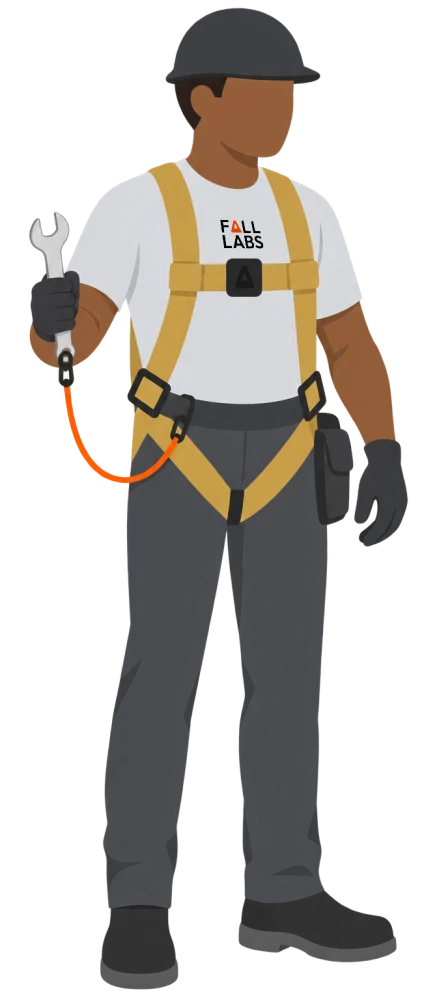
A wrench slips out of a glove on a platform three levels up. The worker who dropped it is protected from falling, but the people below are exposed to what falls. The U.S. Bureau of Labor Statistics (BLS) counted 357 workplace deaths in 2024 in which a worker was struck by a propelled, falling, or suspended object, a broad category that includes objects dropped from height.
ISEA describes active controls such as tool tethering as a rapidly growing way to keep hand tools and small parts from becoming dropped objects, and the market offers tethers, attachments, and tool bags with a wide range of ratings and claims. ANSI/ISEA 121 is the consensus standard that sets a common test and labeling baseline for that equipment.
What OSHA requires
The Occupational Safety and Health Administration (OSHA) addresses falling objects directly. In general industry, 29 CFR 1910.28(c) requires the employer to ensure that each employee exposed to falling objects wears head protection, and to use at least one other measure: toeboards, screens, or guardrail systems; canopies with materials kept back from the edge; or barricades that keep people out of the area below. In construction, 29 CFR 1926.501(c) sets a similar rule with hard hats and the same three options.
Those provisions do not mention tool tethering. Tethering is an active control that employers can add on top of them, because it stops the object from falling in the first place rather than protecting the people it might land on. The rules discussed here are United States rules, and requirements elsewhere differ.
What the standard covers
ANSI/ISEA 121-2023, the American National Standard for Dropped Object Prevention Solutions, is published by the International Safety Equipment Association (ISEA) and approved by the American National Standards Institute (ANSI). The first edition appeared in 2018, and ISEA describes it as the first standard of its kind. The current revision took effect on July 2, 2024. It sets design, performance, testing, and labeling requirements for four categories of equipment:
- Anchor attachments, which create a connection point on a person or a structure for a tool tether.
- Tool attachments, which create a connection point on a tool that did not come with one.
- Tool tethers, which connect the tool to the anchor.
- Containers, such as tool bags and buckets used to carry tools and parts at height.
Some things fall outside it. The tool itself and the primary anchor, whether a worker’s body, a lift, or a structure, are not covered. Neither are passive measures such as netting, barricades, and toeboards, protective equipment such as hard hats, or hoisting and material handling. It is also separate from the ANSI Z359 fall protection standards, which protect the worker from falling, while ANSI/ISEA 121 keeps the worker’s tools from falling on someone else.
How products are tested
Anchor attachments, tool attachments, tool tethers, and portable containers are all drop-tested, and the tests are repeated after conditioning in four environments: ambient dry, soaked in water, cold at minus 31 degrees Fahrenheit (minus 35 degrees Celsius), and hot at 113 degrees Fahrenheit (45 degrees Celsius). Each condition calls for at least three drops, so a product sees at least twelve drops across the four conditions. Products designed for a range of tool or anchor sizes are tested in the weakest orientation within that range, and a product passes only if nothing fails in a way that lets the test weight go.
Tool tethers have the toughest drop test. In each of the four conditions, the first drop uses a weight equal to twice the published capacity, falling twice the tether length, and the next two drops use a weight equal to the published capacity. Anchor attachments, tool attachments, and portable containers are drop-tested at their published capacity, and containers also go through static load tests. Stationary containers are static-tested, though any anchor points or tethers built into a container are also drop-tested. Any carabiners or snaphooks used on tethers and containers must have locking gates and captive eyes.
What a rating means in use
A published capacity describes what the component was tested to hold, not a working load for every situation. The standard’s informative guidance says to know the weight of each tool before tethering it. Every component in the system, from the anchor attachment through the tether to the tool attachment, should be rated at or above that weight, because the system is only as strong as its lowest-rated part. The tether should be no longer than the maximum length the attachment allows, and workers should be mindful of how much tool weight ends up attached to their body, both from a single heavy tool and from several tools dropped at once.
Length matters for the people below as well. A tethered tool still falls until the tether catches it, so the space below has to allow for that fall. Check the clearance distance in the supplier’s instructions, which the standard requires whenever it differs from the maximum tether length.
Reading the label
ANSI/ISEA 121 requires each product to carry a permanent, legible marking in at least English. The label has to identify the supplier and the part or model number, provide a date of manufacture, lot code, or serial number for traceability, and state the published capacity with its unit of measure and any compatibility limits. It also has to name the standard, ANSI/ISEA 121-2023, and give the tether length for a tool tether or the maximum tether length for an anchor attachment, tool attachment, or container where that applies. The standard’s guidance says not to use a product if that information is absent or illegible. A product can bear the ANSI/ISEA 121 marking, or be described as meeting the standard, only if it meets every requirement, and the supplier must keep a test report and issue a Declaration of Conformity for each model.
The instructions that come with the product carry the rest: warnings, limitations on use, the size range of tools or anchors it fits, inspection details, and the clearance distance when it differs from the maximum tether length.
Inspection and the rest of the program
The standard’s guidance calls for inspecting every component before each use for wear, damage from dropped tools, and cuts from sharp edges, and for removing anything worn or damaged from service, with the supplier’s instructions and site personnel setting the specific interval. The guidance also cautions that temperatures outside the rated range, long exposure to sunlight or salt air, and chemicals can reduce protection. Tethering also works alongside the other controls rather than replacing them. Hard hats, netting, barricades, and awareness of who is working below still apply, and not every tool or part can be tethered.
Choosing attachment points for different tools, and managing the total tool weight a worker carries at height, are topics for future articles.
Sources
- U.S. Bureau of Labor Statistics, Census of Fatal Occupational Injuries, Table 2, Fatal occupational injuries for selected events or exposures, 2023 to 24.
- OSHA 29 CFR 1910.28(c), protection from falling objects (general industry).
- OSHA 29 CFR 1926.501(c), protection from falling objects (construction).
- ANSI/ISEA 121-2023, American National Standard for Dropped Object Prevention Solutions.
- International Safety Equipment Association, ISEA Releases Updated Dropped Objects Standard, July 16, 2024.
Last reviewed: September 2026.
This article is for general informational purposes only. It is not legal, medical, or engineering advice, and it does not replace hands-on training, a site-specific hazard assessment, or the judgment of a competent or qualified person. Always follow the manufacturer’s instructions for your equipment and the regulations that apply where you work, and check with the authority having jurisdiction when in doubt. Standards, regulations, and research cited here were current when this article was written and may since have been revised, reaffirmed, or withdrawn. Fall Labs makes no warranty as to the completeness or accuracy of this information and is not responsible for how it is used. References to OSHA, ANSI, ASSP, or any other organization do not imply their endorsement.